
Oxygen Not Included

Oxygen Not Included

141 ratings
Fully Automated Drecko Ranching
By Magialisk
A step-by-step walkthrough for constructing simple, automated drecko ranches.
4
3
3
2
13
   
Award
Favorite
Favorited
Unfavorite
1. Introduction
Last updated 01/10/2026 for the November 2025 QoL Update - Build 700386
That's right, drecko starvation ranching is back!
I never intended to write a guide on dreckos. After my guides for ranching hatches and divergents, I was ready to take a break and actually play the game for a while :)

I've seen some really well done drecko ranches, but for reasons that make a lot of sense I've never seen a single one use a 'critter dropper' to automate repopulation. For that reason I decided to challenge myself to see if a drecko ranch was even possible with a critter dropper design. I figured it would require several compromises in space usage and efficiency, assuming I got it to work at all, but I wanted to try nonetheless.

If you're not following why this might be challenging, there are a handful of unique requirements for ranching dreckos that don't match well with the critter dropper technique:
  • Since dreckos can climb on walls and ceilings, you can't simply leave open doors in the floor for dropped critters to fall through. Otherwise the other dreckos in the stable would crawl through the open doors into the stables above and below.
  • In order to shear dreckos for plastic and reed fiber, they must spend time in a hydrogen atmosphere.
  • Whatever mechanism is used to allow critters to fall between floors would also allow hydrogen to rise and mix with other gasses. Managing gas pressure between floors could be a challenge unless the entire ranch is full of hydrogen.

I ended up building 4-5 designs with working critter droppers, and some of the more exotic ones even included thermo regulators, aquatuners and steam turbines for cooling. But while those results scratched the "challenge" itch, none of them were interesting enough or efficient enough to write a guide about. Then, I stumbled into a drecko ranch design I found truly inspiring:

thegroundbelowme & Beardo09 - Optimized Drecko Ranch Design v3
https://www.reddit.com/r/Oxygennotincluded/comments/qarpve/optimized_drecko_ranch_design_v3/

Within this guide I will refer to the above design as the TGBM/B09 design. My own designs had a lot of empty, wasted space, and though it doesn't look like it on the surface, the TGBM/B09 design does as well. Looking at the two side by side it became clear that I could combine elements from both to remove much of the empty space. And by building the TGBM/B09 design 'upside down' it would allow the integration of a critter dropper from the shearing area into the breeding stable. Ultimately, that is how I came up with my new design, and then decided to write this guide.
2. Objectives
As stated above, this all started as a fun personal challenge, not an exercise in optimizing drecko ranching. Even so, I'll document below what I set out to achieve.

Requirements
  • Must be a “horizontal” stable
    • This is just personal preference; Drecko ranches more than most critters come in all shapes and sizes, but I wanted to emulate my previous ranch designs
  • Must integrate a "critter dropper" to deliver new dreckos to lower levels of the ranch
    • This was the whole point of the challenge, after all :)
  • Must automate all required resource delivery
    • Dreckos don't eat delivered materials, but consume plants directly
    • As such, the resources required to maintain plant growth (dirt) must be automatically delivered
  • Must automate all required resource extraction
    • Plastic
    • Reed Fiber
    • Eggshells
    • Meat
    • Phosphorite
    • Optionally: extra meal lice and mealwood seeds
  • Must automate population maintenance to keep up to eight dreckos in the breeder stable
    • Removal of eggs
    • Addition of new breeding dreckos when required (e.g. after natural death)

Goals / "Nice to Haves" (In approximate order of importance)
  • Should minimize time between breeder death and replacement
    • i.e. should not wait 33 cycles for a new egg to hatch and grow to adulthood
  • Should confine dreckos to a small area to expedite grooming and shearing
    • 2025 update - This is no longer relevant 4 years later after the patches allowing critters to queue for grooming, but there also wasn't any reason to let the dreckos run crazy.
  • Should be relatively easy to build, no tricky order of operations or dupe pathing
    • I'd argue that I failed this objective due to the vertical liquid locks required, but I'll provide a tip on how to build those in the construction section
  • Should try to keep automation requirements reasonable (subjective, I know)
3. Mark III - What's New This Time?
I can't believe I'm rewriting this guide for a third time! To be fair, we made it 3 years and 3 months after the Fast Friends patch to drecko feeding mechanics, so that was a pretty good run. The November 2025 QoL update drastically changed scale growth mechanics and all but destroyed starvation ranching for dreckos... or so I thought. As it turns out, most everything about starvation ranching still "works", the critters just need a bit more space to prevent them from becoming "miserable". Crowded is OK, un-groomed is OK, un-fed is OK, pretty much everything else is OK, as long as they're not "miserable". So what does that really mean?

The new miserable status applies when a critter's happiness hits -10. When a critter is miserable all scale growth stops, so it's impossible to continue shearing dreckos for plastic or fiber. Importantly this is a binary status, it's either applied or it's not. I don't want to give Klei any ideas, but thankfully there's no linear reduction in scale growth the more unhappy a creature gets. It's 100% growth down to -9 happiness and 0% at -10 or "miserable".

With that understood we need to determine what factors affect a critter's happiness. All of our dreckos will be tame, so they start at -1. We will not be grooming the critters in the starvation/shearing chamber, so that -1 penalty will be permanent. Speaking of starvation, critters with 0 calories become "starving" and also automatically apply "miserable" regardless of their happiness score. Dreckos will have already been sheared ~7 times before they run out of calories, after which they'll become miserable and simply take up space for 10 more cycles until they die.

Finally we come to space, the other parameter affecting happiness. Each drecko normally requires 12 tiles of space to prevent being "crowded". For example, a full-sized 96-tile stable can comfortably hold 8 dreckos, but adding a 9th would make them all crowded. After this QoL update, the crowded debuff applies a -1 happiness penalty for *each* additional critter sharing the space. Considering the smallest 12-tile space with a single tame drecko inside, it would be at -1 happiness from the tame, but not crowded. Adding one extra decko would make them both -2, another gives -3, and on until an 8th extra drecko would make them all -9. Finally, a 9th extra drecko pushes them all to -10 happiness, applying the miserable debuff.

This is the key mechanic any redesigned starvation ranch need to work around. Instead of cramming an "infinite" number of dreckos into a single starvation/shearing chamber, the dreckos need to be divided between multiple chambers, with no more than 8 "extra" dreckos in any given chamber to maintain -9 happiness or better. It seems worth noting that while any eggs in the same room will add a "cramped" debuff, this debuff does not impact critter happiness thus cannot cause them to be miserable. So eggs can be safely stored in the starvation/shearing rooms.

I loaded up several old saves of colonies that had built my old drecko ranch and run for collectively thousands of cycles. Each of them had between 20 and 30 dreckos in the starvation/shearing room. With that information I decided to split the old design into two shearing rooms, so that each could support 8 "extra" dreckos, accounting for 16 total. That leaves no more than 14 dreckos (totaling 30) that need to be provided adequate space in the shearing rooms. So the new design should ideally provide either one room of 96-tiles (holding 8+8) and one of 72-tiles (holding 6+8), or two rooms of 84-tiles (holding 7+8 each).

The design I settled on went with the former option. We end up with one 96-tile shearing room and one 77-tile shearing room, supporting up to 30 starved dreckos at a time. The population of the larger room is controlled at no more than 16 dreckos, so you'll always be able to shear some plastic and fiber in that room. If the second smaller room becomes overcrowded and miserable then scale growth in that room will pause until a critter or two die off. In a couple hundred cycles of play testing I rarely noticed this and was always producing massive amounts of plastic. If you're especially concerned with maximizing plastic production, then a critter sensor tied to an alarm could alert you of this situation, allowing you to manually cull dreckos with the starving status, preventing any pause in plastic production.

Comparison of Old and New Design Features
  • Overall size / construction
    • OLD: Two "standard" 24x4 rooms, one 64-tile starvation/shearing chamber
    • NEW: Three "standard" 24x4 rooms, two starvation/shearing chambers totaling 170+ tiles
  • Utility Area
    • OLD: Stable contains a 14x4 open area to add whatever you like
    • NEW: Stable contains three open areas, 14x4, 7x4 and 11x4 to add whatever you like
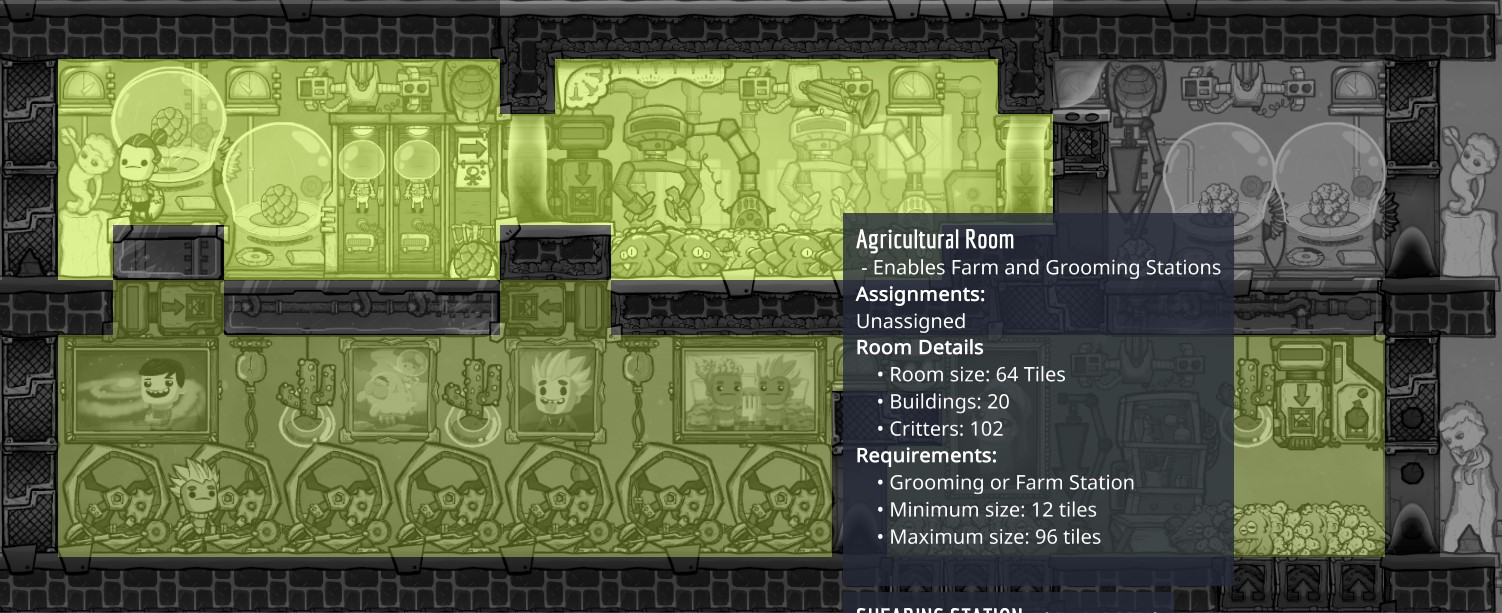
      • Note: As with any ranch, you must be careful not to add conflicting buildings that would attempt to turn the space into a different room, thus losing the stable designation. For example, a single research station is fine, but two science buildings would attempt to create a laboratory and invalidate the stable.
  • Incubators
    • OLD: Supports up to 4 incubators, two for glossy dreckos and two for regular dreckos.
    • NEW: Supports up to 2 incubators, one for glossy dreckos and one for regular dreckos.
      • Note: I don't believe extra incubators would benefit this new ranch, since eggs don't count against drecko happiness while baby drecklets do. The single incubators will produce a steady stream of dreckos to repopulate the breeders and shearing stables, without unnecessarily increasing the chances of overcrowding.
4. Bottom Line Up Front - The Design
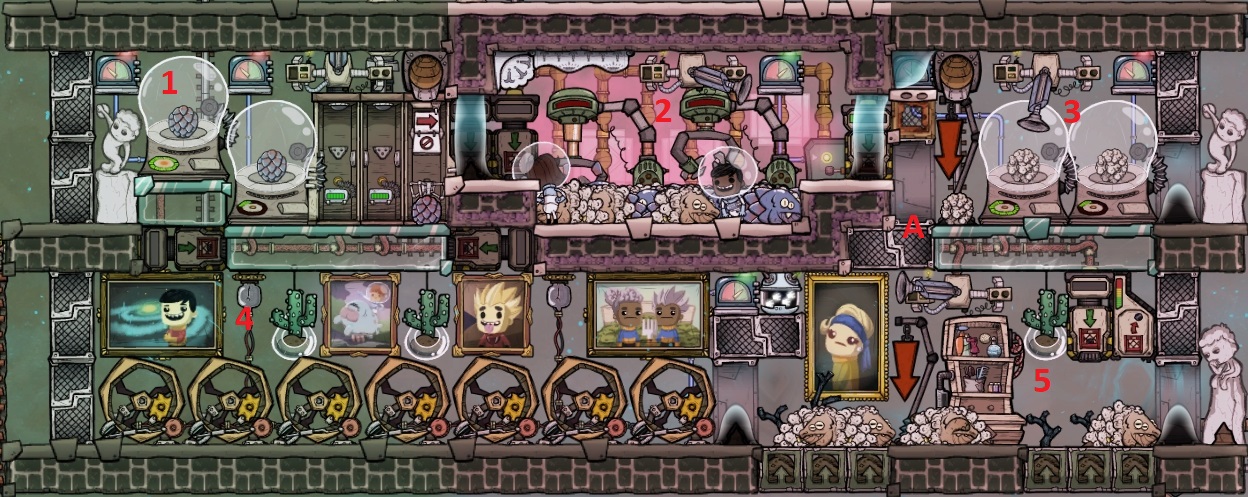
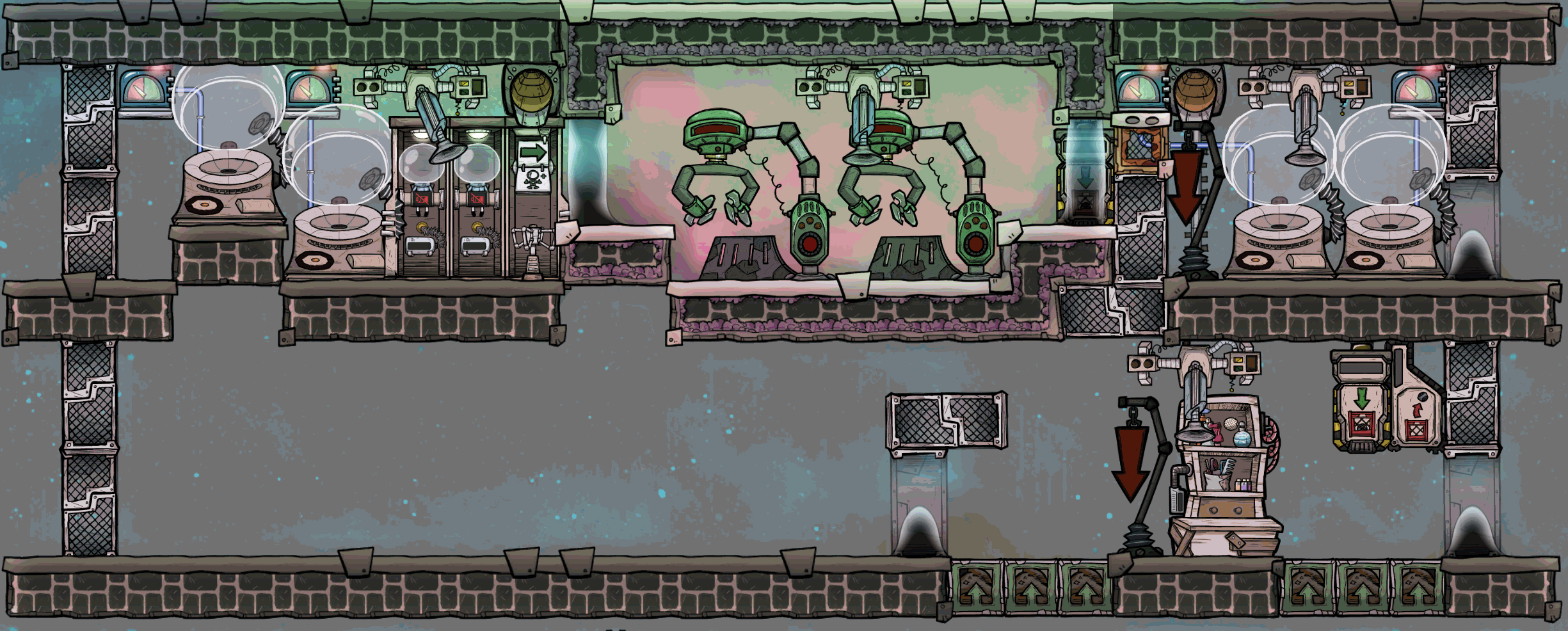
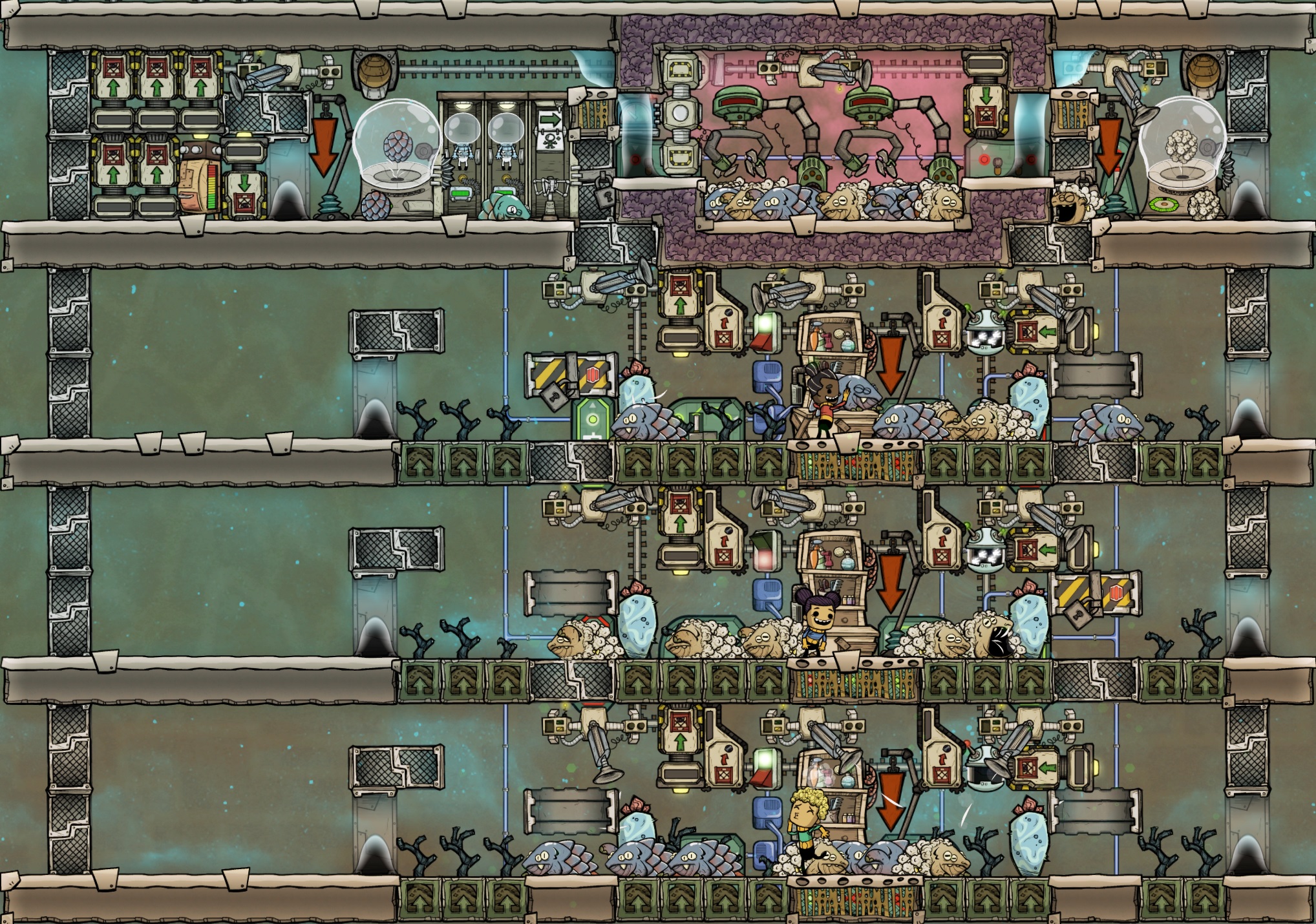
The updated design still consists of a control room paired with a single breeding stable. Both rooms use a "standard" 24x4 layout, however the control room is now two floors high. For comparison, examples of both the previous MkII and latest MkIII designs are shown below:

Unlike my ranch designs for other critters, this is not intended to be stacked. There is little reason to have more than one stable of breeding dreckos, especially after the QoL addition of the 'miserable' status. All non-breeder dreckos are kept in a hydrogen chamber full time to maximize shearing output, but shoving too many in that chamber would stop all resource production.

The Control Room
The control room generally consists of two chambers which I’ve subdivided into labels 1A/B, 2A/B, 3, 4 and 5 in the screenshot above.

Chamber 1 - Incubation and Primary Shearing
This area consists of the four right-side sub-areas labeled 2A, 2B, 4 and 5. The first three sub-areas all combine to form a single 96-tile stable, separated by a door from sub-area 5. This stable is population controlled to contain no more than 16 (8+8) dreckos of both types.

Area 2A is the first of our utility areas, 11x4 in size. It counts towards the stable size but can be used for whatever buildings you like that won't de-activate the stable.

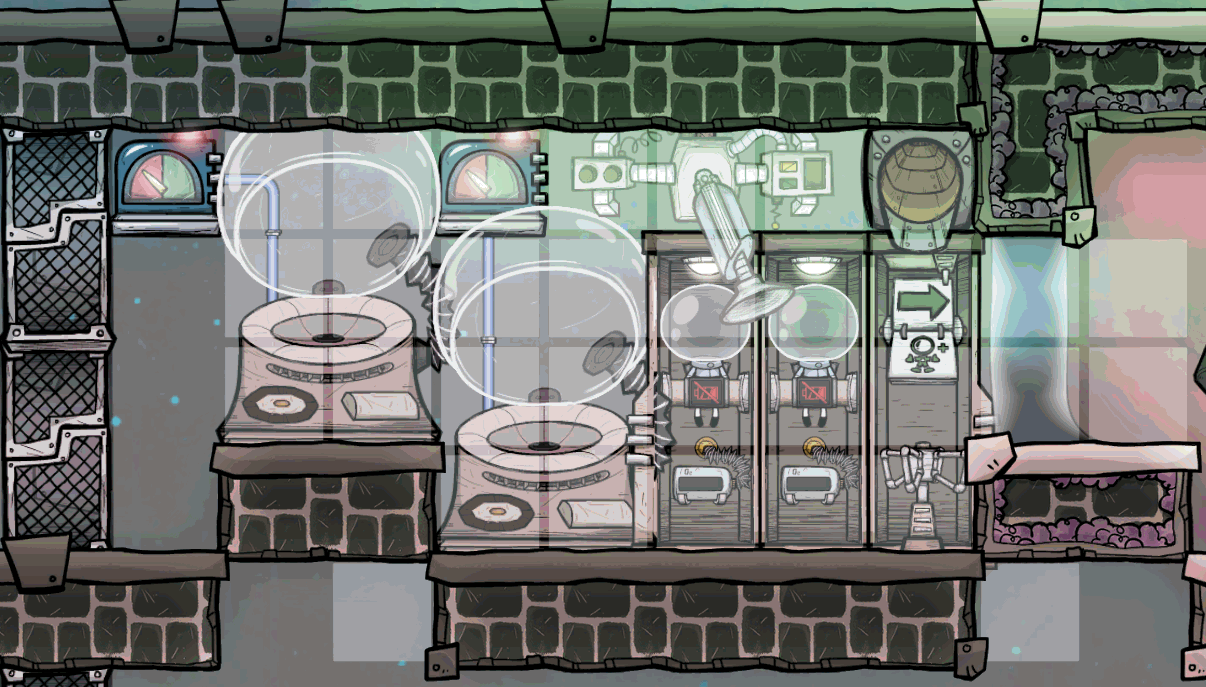
Area 2B is the shearing area, containing a shearing station and critter pick-up. Dreckos are confined to the floor, unable to climb up the walls on either side due to the step and liquid lock. The purpose of the critter pick-up is to remove any extra dreckos if the total goes above 16. These extra critters will be deposited in the secondary shearing chamber to the left.

Areas 4 and 5 are for incubating glossy and regular dreckos, respectively. The stair-stepped floors and liquid locks are specifically constructed to ensure dreckos can only ever move to the left through these areas. A critter dropper in Area 5 will push drecklets into the breeder stable (6B) whenever a new breeder is required. Otherwise, after 5 cycles the drecklet will become an adult and crawl left into Area 4. In Area 4, glossy drecklets will be stuck, unable to move right into the critter dropper and contaminate the breeder population. Adult dreckos (of either type) will move left into the shearing area to live out the rest of their lives.

Chamber 2 - Entrance and Secondary Shearing
This area consists of the three left-side sub-areas labeled 1A, 1B and 3. All three areas combine to form a 60+ tile stable, separated from Chamber 1 by the stacked doors.

Area 1A is the second of our utility areas, 7x4 tiles in size. Just like Area 2A, this can be used for anything you like that will not break the stable.

Area 1B is the shearing area, containing a shearing station, a critter drop-off and an overhead auto sweeper. The purpose of the critter drop-off is to ensure that if the breeder stable or primary shearing stable ever become over-crowded, the extra dreckos will be relocated here. This chamber is not population controlled, so containing more than 13 (5+8) dreckos will cause the miserable status and pause scale growth temporarily. There is plenty of room to add a critter sensor and alarm to inform you of this condition and allow a manual culling of extra dreckos, but I didn't find that particularly necessary. Usually when this happens some extra critters are within a cycle or two of starving to death anyway, so the problem rapidly resolves itself. The auto-sweeper in this room is responsible for exporting all resources from the ranch. From its central position it can see the entire floor space to pick up any dropped items, and can reach up to 12 conveyor loaders, far more than we could ever make use of. Any resources created in areas 4, 5 and 6A are first deposited in area 2B, where they are sorted and exported by this sweeper.

Finally, Area 3 provides the entrance to both shearing areas, through two atmo-suit docks. This allows ranchers to operate both shearing stations simultaneously, optimizing the flow of resources. Duplicants cannot climb up or down from areas 1A or 2A, and the door between areas 4 and 5 is configured to disallow dupe travel. In this way, Area 3 provides the only access into or out of the shearing stables.

The Breeding Stable
The breeding stable is fairly straightforward. The areas marked 6A and 6B combine to form a 96-tile stable able to hold up to 8 breeder dreckos. These dreckos are fed and groomed to maximize egg production and keep the shearing chambers full.

Area 6A is the third of our utility spaces, measuring 14x7. You should know by now what you can do with this space.

Area 6B is where the breeding dreckos are contained, unable to climb up the doors due to the liquid locks. Six mealwood plants provide just enough food for eight dreckos after the Fast Friends bug fix. The critter pick-up ensures that the stable never goes above 8 breeders. Because the critter dropper in Area 5 is an extremely simple design, it may occasionally drop more than one drecklet into the breeding stable. We can't afford the space for more complex and reliable critter droppers, but with this critter pick-up any mistakes are corrected quickly.
5. Construction
The following sections describe how to build both the control room and the breeding stable in a progressive fashion. The expectation is that you would begin the early game with a fully manual ranch and an empty control room, then gradually build up to the final design.
- Early Ranching - Zero Automation
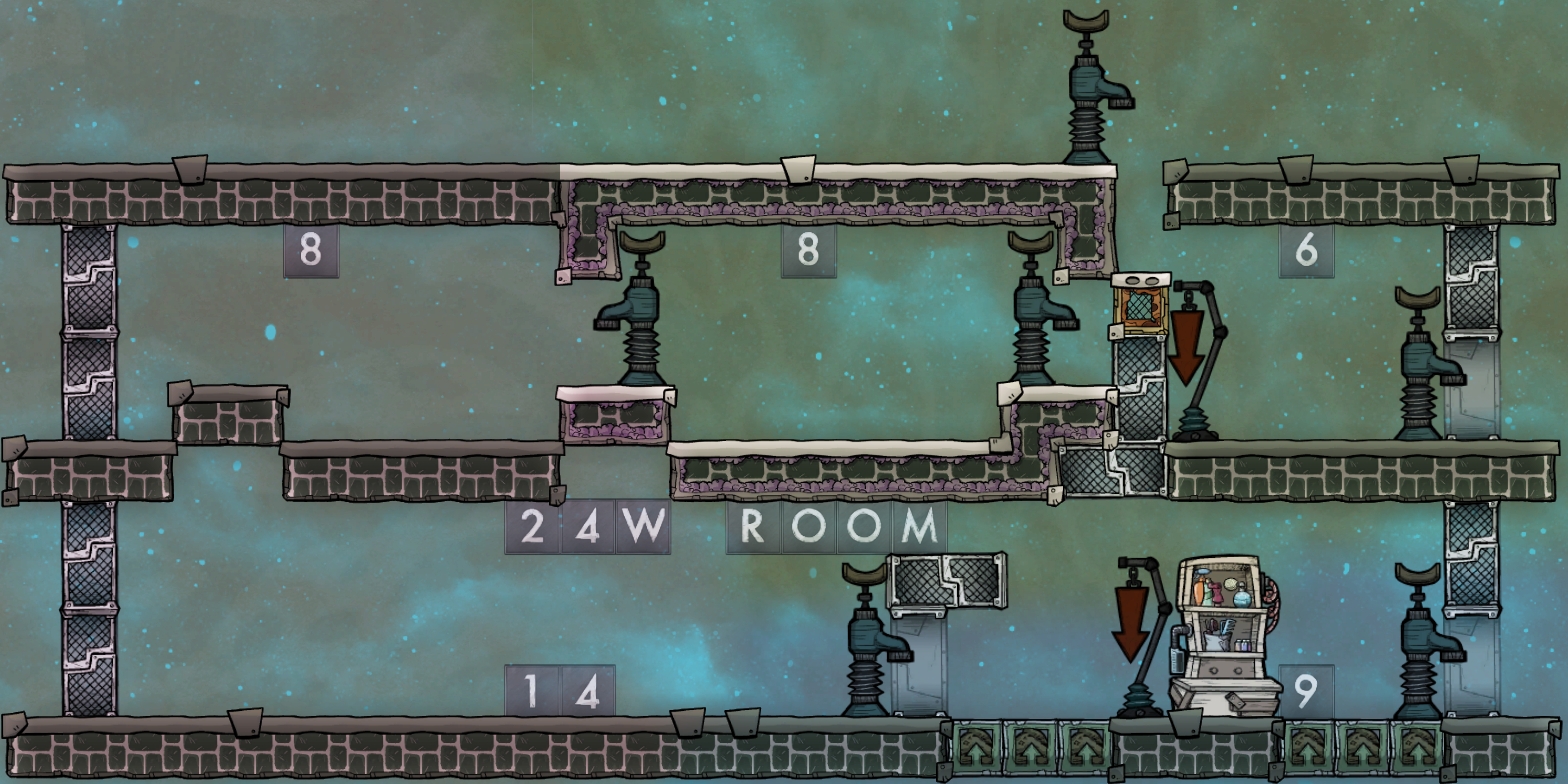
By far the most difficult part of this build is at the very beginning, with the vertical liquid locks. Note that I recommend changing the three tiles under the grooming station and critter pick-up to airflow tiles as soon as you can. Otherwise CO2 will build up between the liquid locks and be unable to escape.

Here's the initial layout:


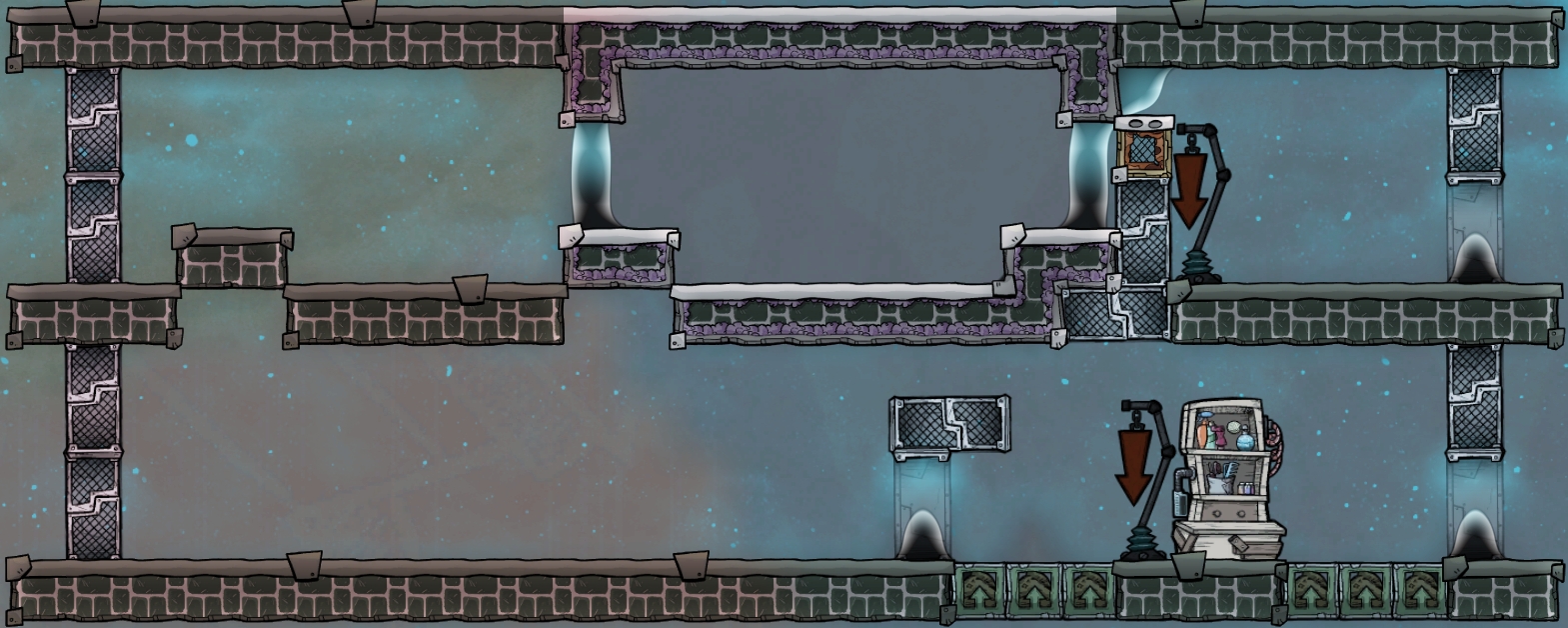
And with the locks established:


Notice that a tile was left open above the door marked in yellow and the airflow tile to facilitate dropping water there. Once a drop of water is above the airflow tile, the regular tile is constructed above it, completing the lock.

Do not forget to set the four doors marked with green to 'open' (not auto), and the six doors marked with red to 'auto'. If any one of these doors is set incorrectly you'll be chasing escaped dreckos off the ceilings later on.

The one door marked in yellow must also be set to disallow duplicant travel in either direction (uncheck the left and right arrows). I recommend setting the four green doors to disallow dupe travel as well. This forces dupes to use the doors above the liquid locks, preventing the 'soggy feet' and 'sopping wet' debuffs.

All doors not marked with a colored rectangle may be set to whatever open/auto state you prefer.

Building the Liquid Locks
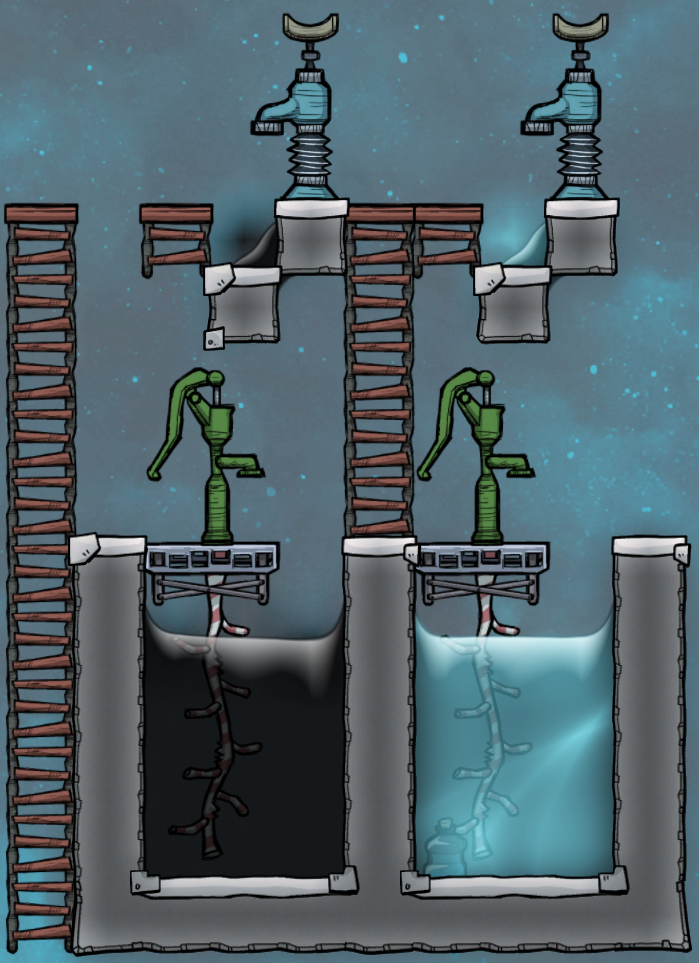
All of my locks are shown using water on top of crude oil, with the exception of a single drop of water above the yellow door's airflow tile. You can't see the top liquid when the lock is below a door instead of a tile, or when it's next to an airflow tile, but they all work just the same. Here's the liquid overlay for maximum clarity:
.jpg]

You can build your locks out of any 2 liquids, water over brine or polluted water works fine, but given the tiny quantities required and oil's much higher density, I believe oil + water is the best early-game approach.

If you're having trouble locating crude oil (e.g. Spaced Out!) there will be much more than enough near the teleporter, which you can mop and bottle. Note that polluted water will not off-gas once a lock is established, however if anyone makes a mess near one of your locks the lock will instantly break from their polluted water. I'd recommend any other liquid as the bottom layer for this reason.

The toughest part of construction is obtaining the tiny drops of liquid required for the locks. The oil on bottom can be any amount 350g or less (I've tested down to 30g), and the top water is in the 30-35g range. Trying to use a bottle emptier and then mop the excess will be a huge pain, especially when applying the top liquid. Too large a droplet on top will push the bottom liquid aside and not form a lock, forcing you to start over. Instead, I recommend the stair-pouring method shown below.

I take no credit for this approach, but the best way I've seen to create small droplets of liquid are using a stair-step design, like this:


The small blobs of liquid trapped on each step after the rest flows away are always a perfect amount to form a vertical lock. You can build a staircase like this using regular tiles and create all the blobs you need from a single pour of the bottle emptier, then mop the steps into individual bottles. This works for all other liquids as well, but if using polluted water be prepared to mop and use the bottles quickly to prevent too much offgassing.

Once the small blobs are bottled, the bottles should be moved to the required locations using the "relocate here" command. Command the bottom liquid bottles (oil, in this example) to be emptied first, leaving the small blob on the floor. Then empty the top liquid bottles (water). This is the easiest and most consistent process I've found to create these vertical locks. Very rarely the process will fail and the water will fall to the side of the oil. I believe this happens if the dupe exhales at exactly the same moment as they empty the bottle, or some other packet of gas prevents the water from taking the desired tile. Regardless, it is super easy to mop both liquids and repeat the emptying process.

Early Ranching
Unless you're in a hot starting biome, you won't need cooling for the mealwood right away. The dreckos have a body temperature of 35C / 95F and mealwood stifles at 30C / 86F, but it will take time to soak that heat into the surrounding tiles and stifle the plants. Once you have drecklets warming up the incubator rooms and a full shearing room slowly leaking heat, it will likely become impossible to keep mealwood growing without running your base cooling loop over the plants.

The critter pick-up in the breeder stable should be set to count glossy and regular drecko and drecklet types, with a maximum of 8 allowed.

The critter pick-up in the right shearing stable should be set to count glossy and regular drecko and drecklet types, with a maximum of 16 allowed.

The critter drop-off in the left shearing stable should be set to allow glossy and regular drecko and drecklet types, with a maximum of 40 allowed.

Note on the Shearing Room
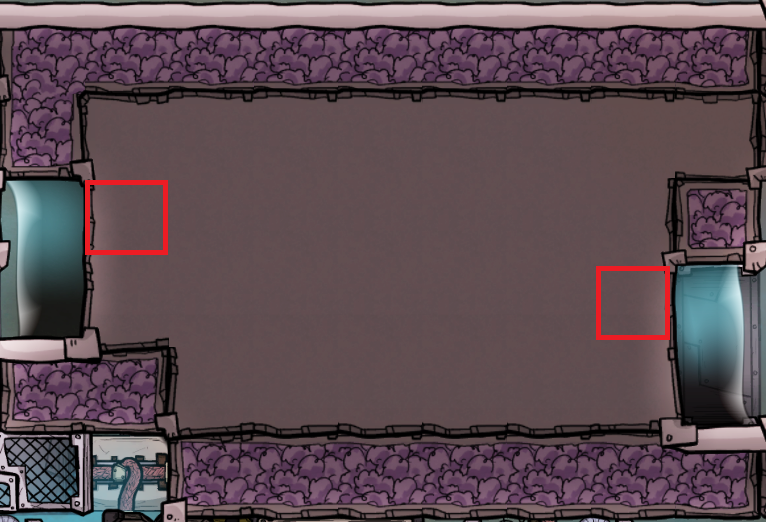
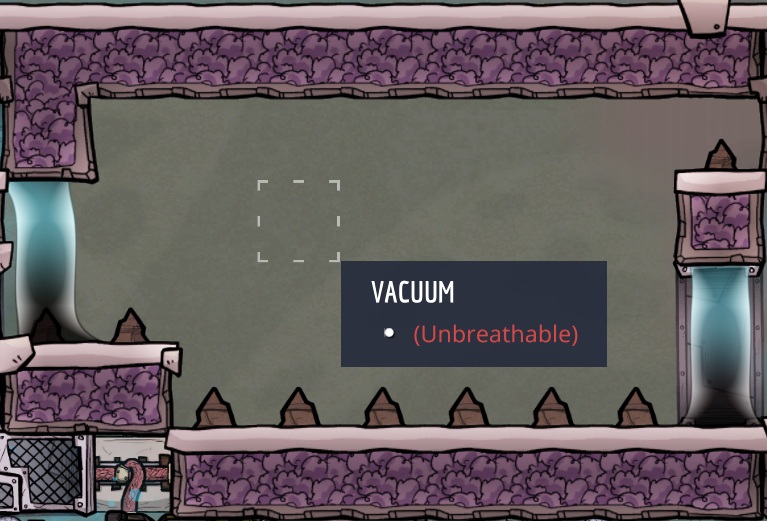
Eventually you will need to create a vacuum in this room. The easiest way is to install a gas pump as shown and let it run. The room will become a vacuum long before you need it, and the pump will automatically turn off and consume no power once vacuum is reached.
- 1st Upgrade - Egg Removal & Dirt Supply
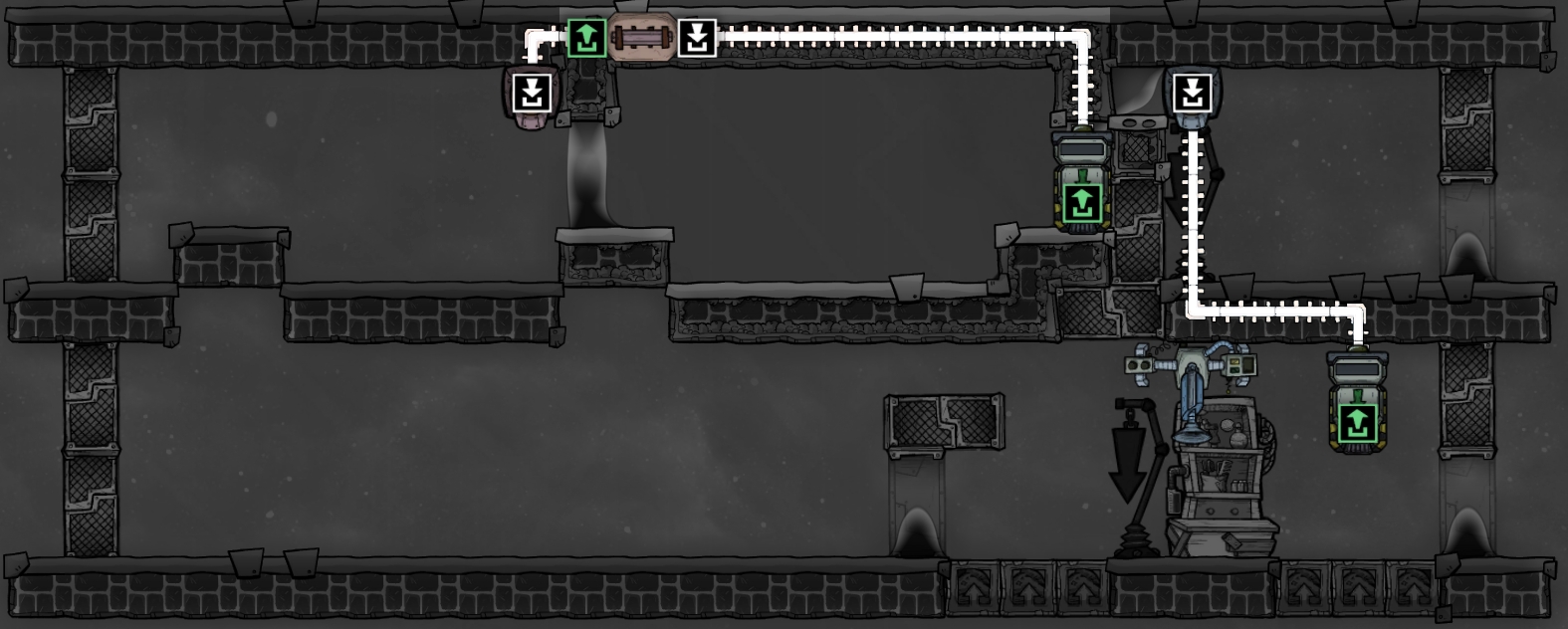
As soon as you acquire the Mechatronics Engineering skill and the appropriate research, the first thing you’ll want to automate is extraction of eggs from the stables. This is primarily because if eggs are left in a stable you will suffer from the ‘cramped’ debuff, preventing more eggs (and thus meat, plastic, reed fiber, etc.) from being produced.

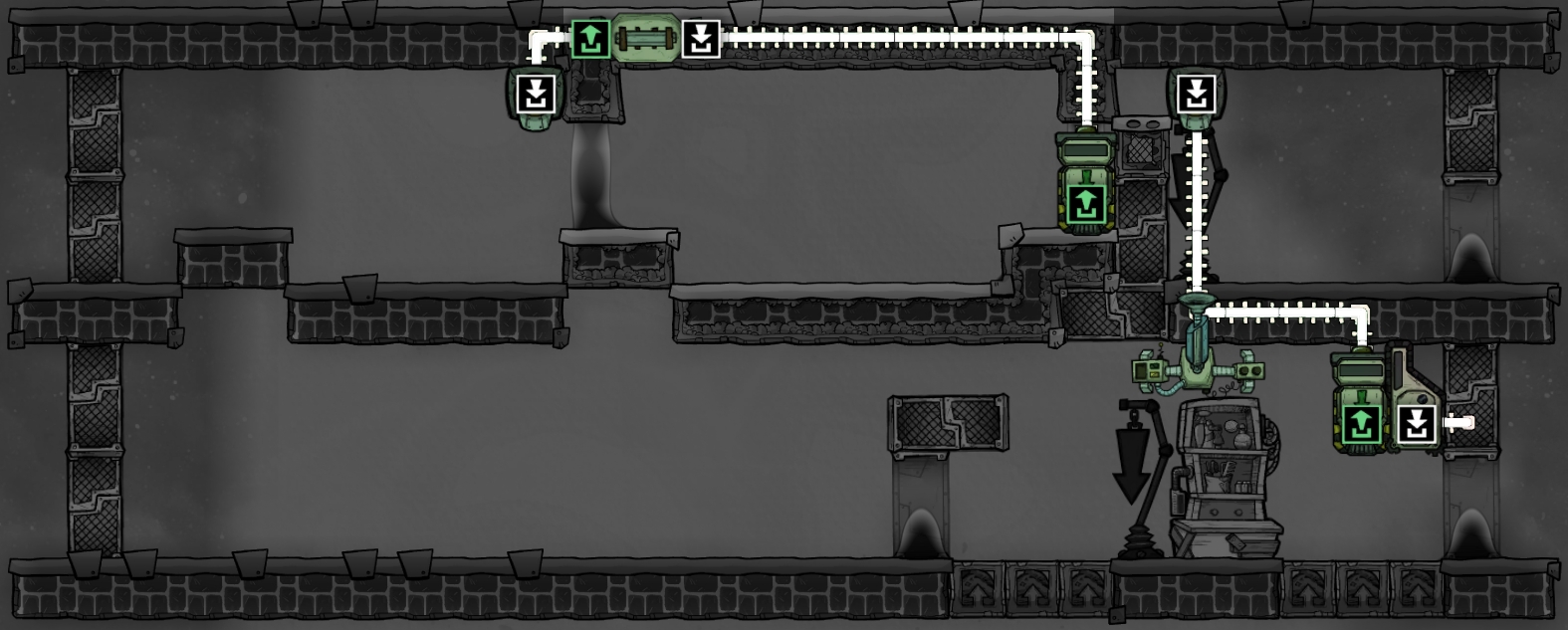
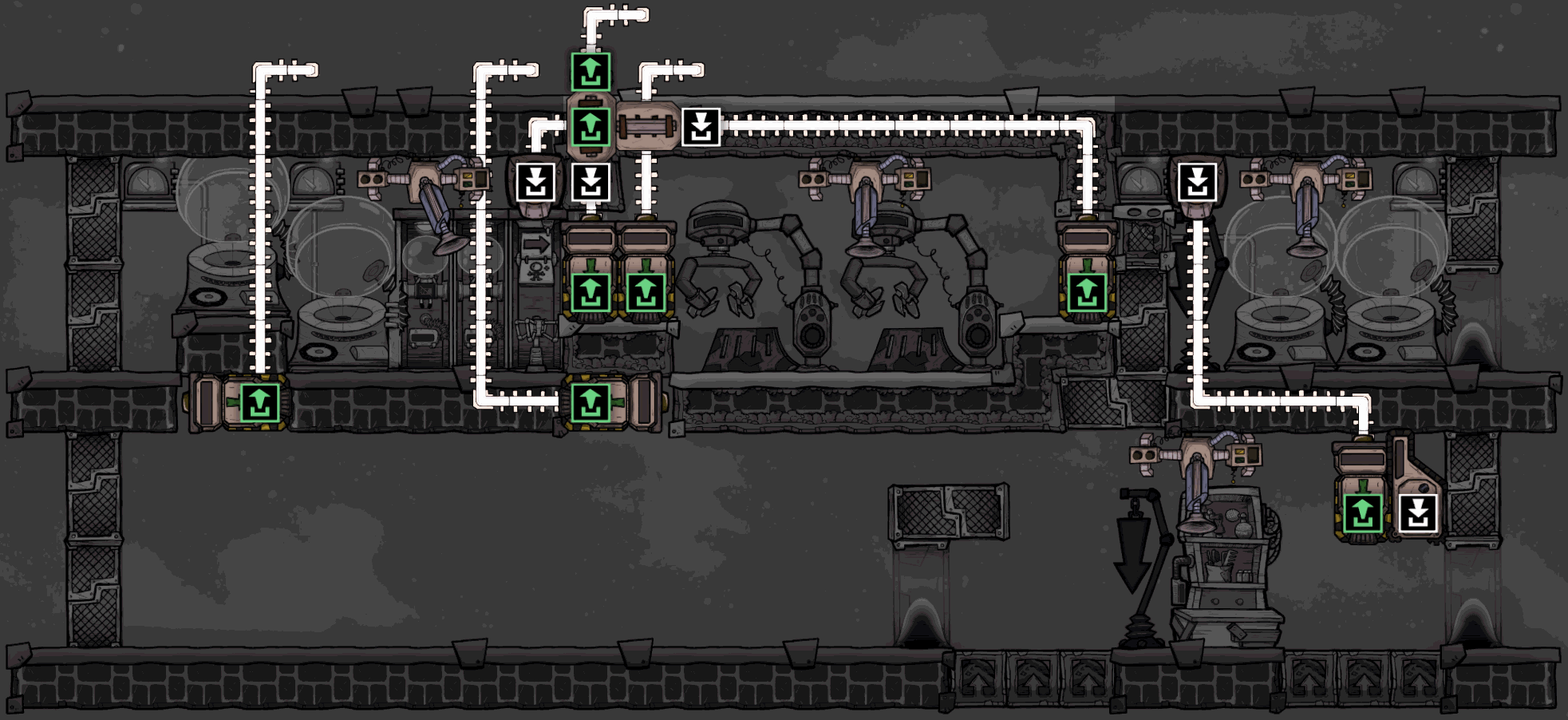
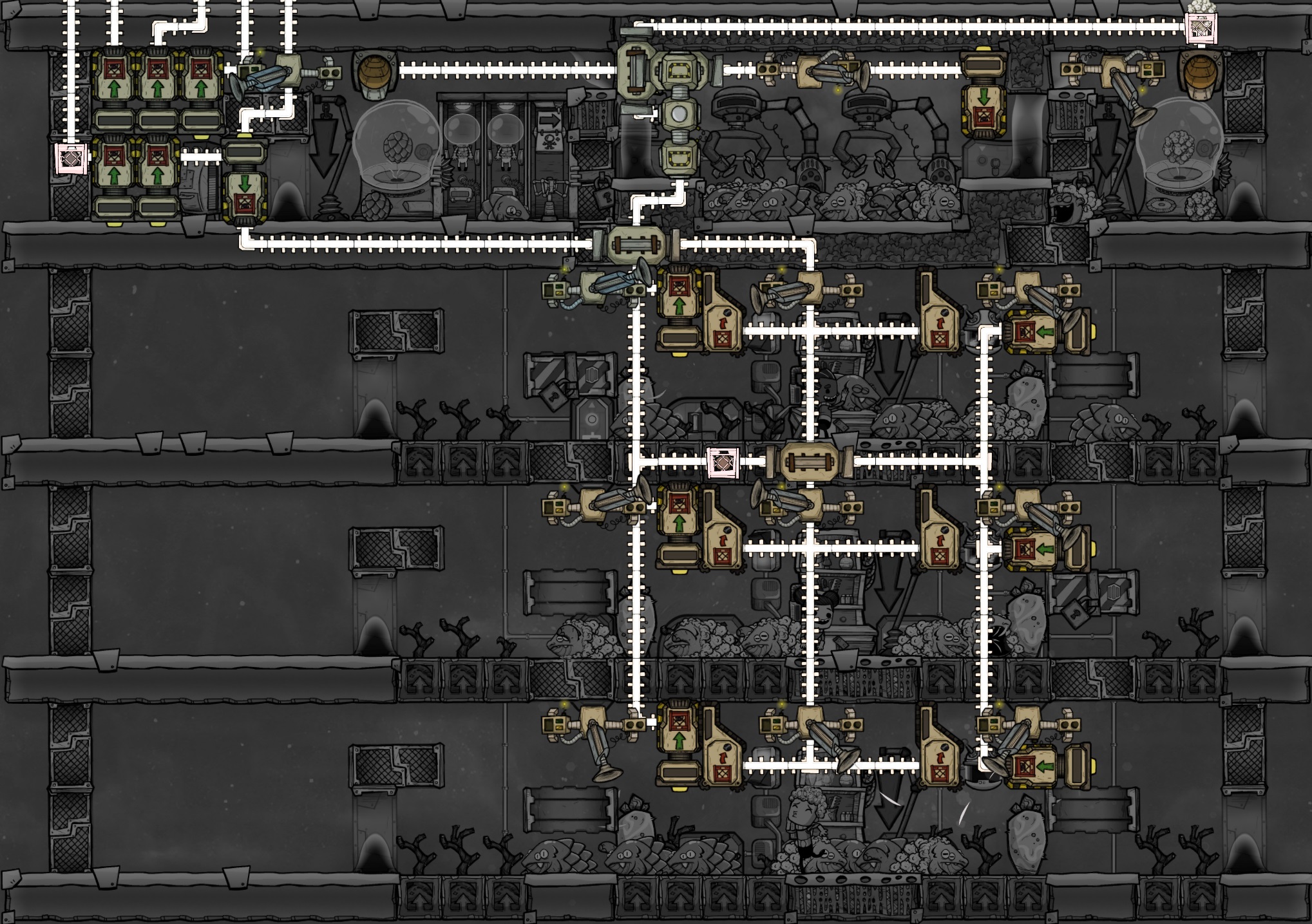
This upgrade requires 600 refined metal to build one auto-sweeper and two conveyor loaders, as shown in the shipping overlay.
.jpg]

I won't show any power overlays in this guide, since the layout is so simple. Just make sure you provide power to everything that needs it. I tend to run horizontal power busses through the floors, then everything connects up or down to the nearest power bus. You can do what you like, as there is nothing tricky about this layout.

The loader on the left goes straight up to a chute where we'll eventually incubate regular drecko eggs. As such it should be set to only allow drecko eggs.

The loader on the right goes straight up and then hops across to the left using a conveyor bridge. It connects to a chute where we'll eventually incubate glossy drecko eggs. As such it should be set to only allow glossy drecko eggs.

The conveyor receptacle on the far right should be connected to a supply of dirt from another storage location in your base. This dirt will be automatically fed to the plants by the auto-sweeper. This is purely optional, you can rely on dupes to manually fetch dirt whenever the plants need it, but the purpose of this guide is maximizing automation to save dupe labor.
- 2nd Upgrade - Incubation
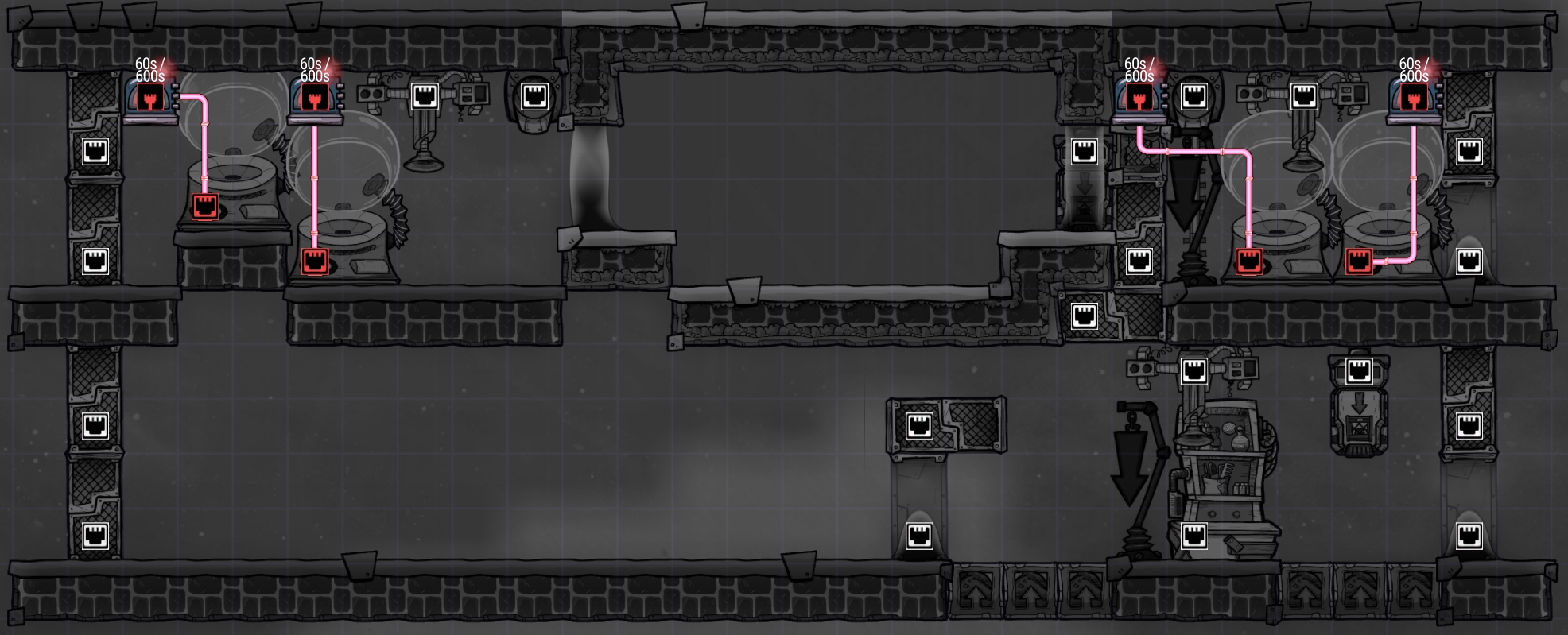
We now install the two incubators along with some minor automation to reduce their power consumption. Each incubator should be set to continuously hatch eggs of the respective type, regular dreckos on the right and glossys on the left.

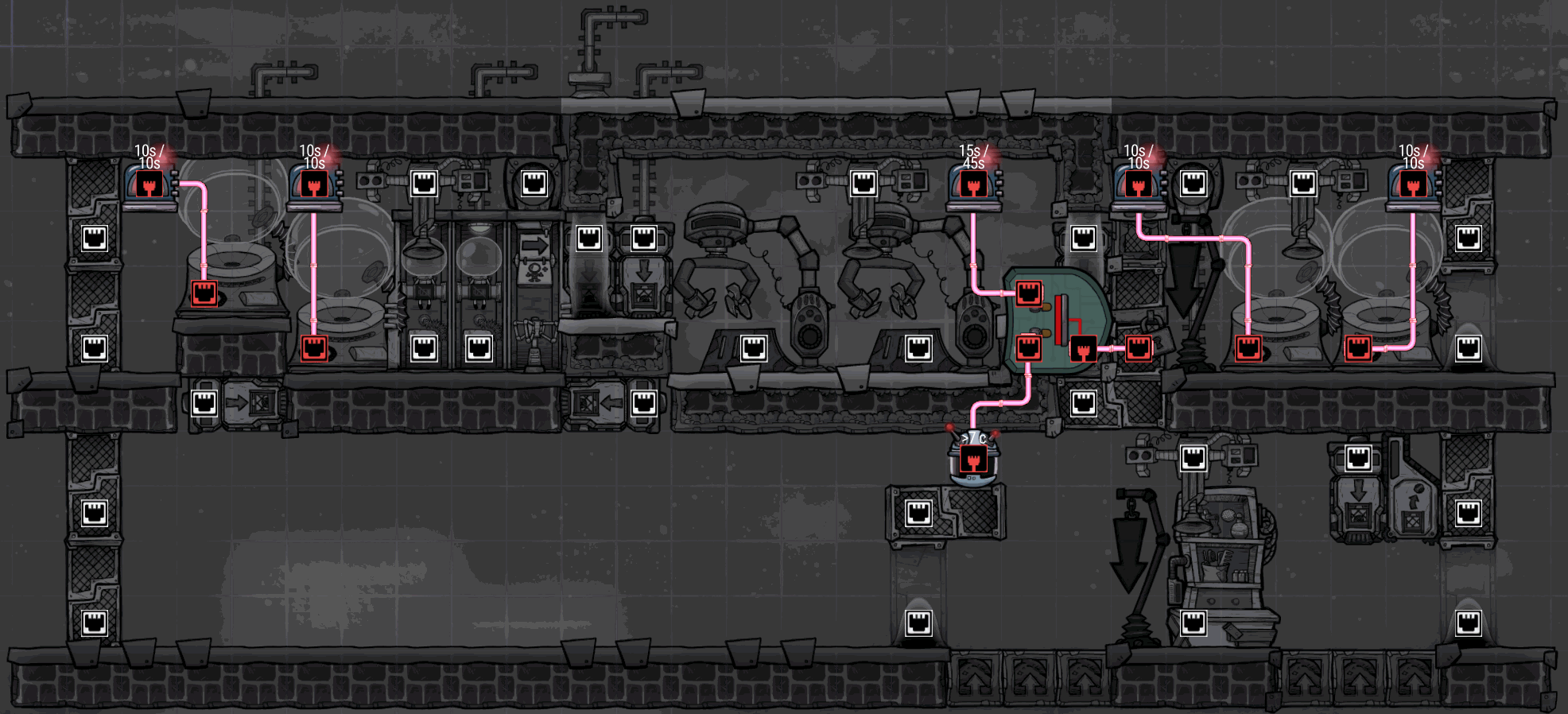
This upgrade requires a total of 695 refined metal, 200 for a second autosweeper, 200 for each incubator, 50 for the two timers, and 45 for nine pieces of automation wire.
.jpg]

The new sweeper in the middle can reach both incubators, as well as the two piles of eggs being dropped from the chutes. It will automatically refill the incubators after an egg is hatched and the baby critter is removed. In a future step this same sweeper will also be used to export materials such as egg shells that are generated in this room.

The automation using timers could be considered an exploit by some, but it's been in the game for so long it feels intentional, and there are several other ways to get the same effect (e.g. disabling buildings via mechanized airlock floors). If you consider this automation an exploit feel free not to use it and power your incubators continuously. Otherwise I'll describe how it works and what the benefit of the automation is below.

What the timer circuits do is enable the incubators only once per cycle for a period of 60 seconds. These active periods for each incubator should be staggered such that when one incubator is about to be disabled the next incubator gets enabled. This is accomplished using the "reset timer" button on the timer sensors when you first set them up. Once they are all set up and staggered, there will never be more than 1 incubator (or 2 for a few seconds of overlap) powered on at the same time, reducing the load on your power wires. When any incubator powers on, a rancher will rush over and hug the egg (I recommend raising the priority of the incubators to at least 7 to encourage this), and soon after they're hugged the incubator will power back off. The 'lullabied' buff will remain on the eggs for one full cycle even though no power is being used, and then the process will repeat a cycle later. This allows us to cut the power load of each incubator from a constant 240W to 240W for only 60s (1/10 of a cycle) and then 0W for the rest of the cycle. That's an average power consumption of 24W per incubator for the same effect, a total reduction of 90%!
- 3rd Upgrade - Shearing
This is where we really become a drecko ranch. Note that your first eggs should be laid around 10 cycles after starting to groom dreckos, the first drecklet born around 7 cycles after that (or 33 if you're not using the incubators!), and after 5 more cycles they'll grow to adults and enter the shearing chamber. So you'll want to get this ready within 22 cycles of building the initial stable, or you'll have about 48 cycles if you're not using incubators.

If you haven't already, the first thing you'll need to do is create a vacuum in the shearing room. I used to recommend an alternative method of filling the room with tiles and deconstructing them, but with the odd shape of this new design the best way is to simply pump out the air as mentioned in the initial construction section.

Once a vacuum has been created in the room, the pump should be removed and the room flooded with hydrogen using a temporary gas vent (you can delete the vent afterwards). The quantity of hydrogen is unimportant as the dreckos do not consume the gas, they simply need to soak in it to grow scales. I've tested it even with a few micrograms per tile and there's no difference in scale growth, but I recommend putting in at least a few hundred grams per tile, plus the pink look is kinda neat.

This upgrade costs a total of 300 refined metal for the atmosuit docks and checkpoint to the left. Two shearing stations give us plenty of throughput once the drecko numbers start to grow.


A couple notes on this step
I assume by this time that you've built your first electrolyzer to provide oxygen to your base. If so, it's easy to fill the shearing room with hydrogen from that process, plus supply the atmo suit docks from one of your oxygen lines.

If you don't have atmosuit technology yet you can easily get by without it. The dupes will never exhale in an area where they could not inhale, so they'll never introduce CO2 to the hydrogen-filled shearing room and disrupt scale growth. The only downside of sending in dupes without suits is that they'll get stinging eyes from the hydrogen and increased stress.
- 4th Upgrade - Output Distribution
This upgrade requires 800 refined metal to install one last auto-sweeper and at least three conveyor loaders.

.jpg]

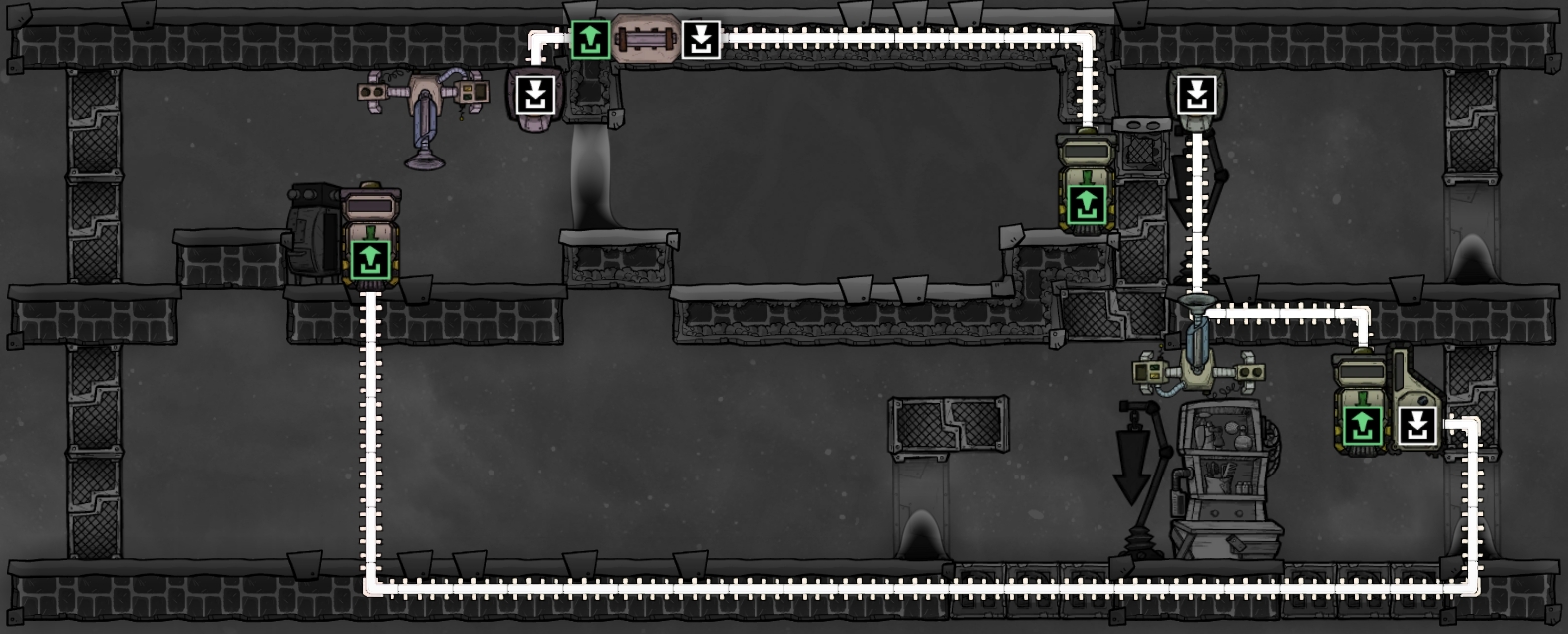
The first loader goes next to the incubators, where it can be reached by both the sweeper to the left and the sweeper below in the breeder stable. This loader should be set to accept everything except eggs and dirt, and it will move all resources to a chute in the shearing room.

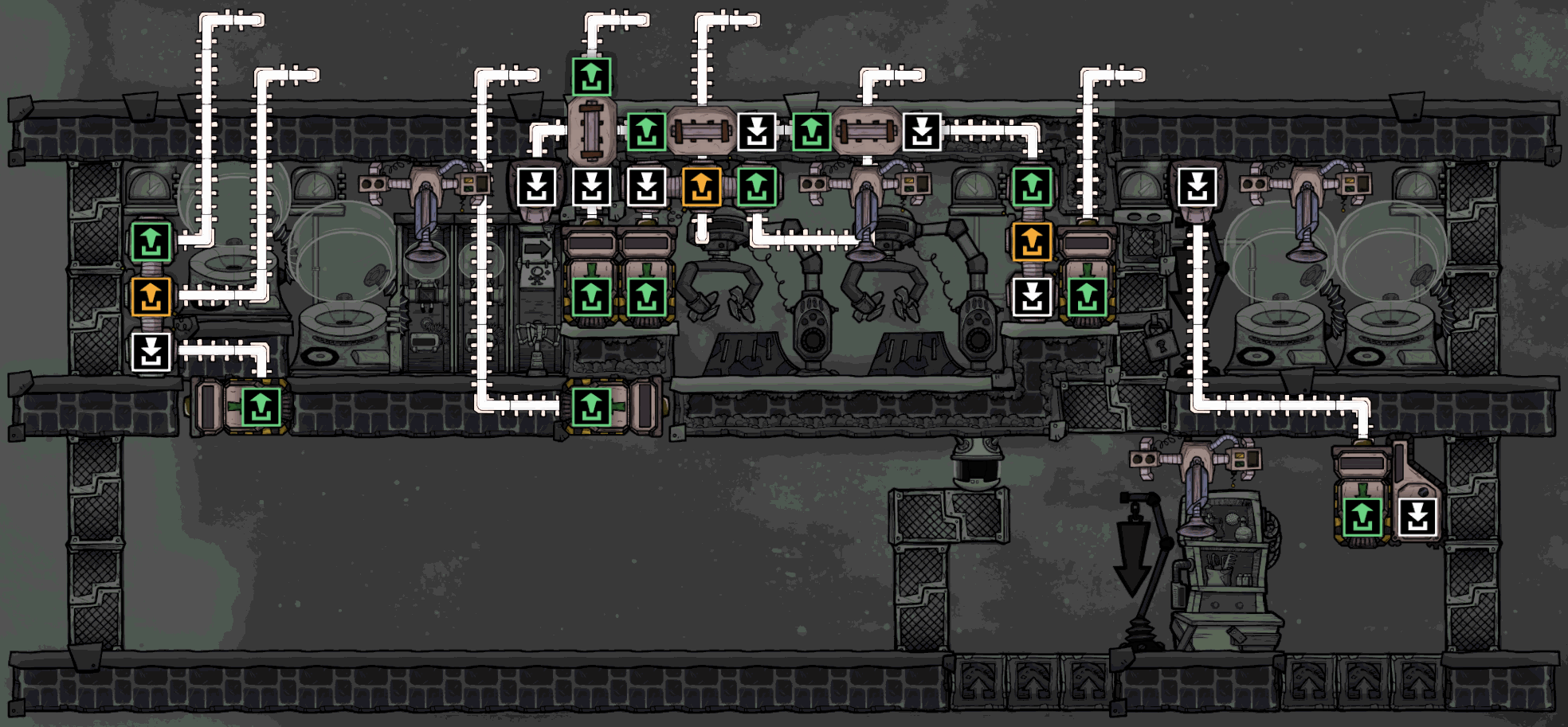
The floor of the shearing room will now be covered in various resources (and likely some construction debris) that need to be removed and sent to your base. This is the job of the final auto-sweeper, and it can be paired with as many as 12 conveyor loaders to separate the resources onto different conveyor lines. The following screenshot shows the reach of the sweeper and every possible location a loader could be installed:


There are as many as seven resources being produced in this ranch that you'll have to decide how to export:
  • Phosphorite
  • Meat
  • Plastic
  • Reed Fiber
  • Eggshells
  • Meal lice (negligible amount)
  • Mealwood seeds (negligible amount)
In the first image above I'm using only two loaders. One loader is set to accept all 'edible' and 'cooking ingredient' items, which it sends directly to my freezer/kitchen. This will remove the meat as well as any meal lice produced.

The second loader is set exactly opposite, it accepts everything except edibles and cooking ingredients. This sends the phosphorite, plastic, reed fibers, eggshells and any mealwood seeds to a centralized storage / warehouse / distribution hub.

As mentioned above, there is plenty of space to customize your distribution with as many different conveyors as you want. Plastic could be sent off to a sour gas boiler, eggshells could be sent into an industrial sauna for lime/steel production, whatever suits the needs of your base can be supported.

A note on Conveyor Bridges
Bridges in general, especially conveyor bridges, are EXCELLENT at transferring heat. There are even exploity builds for steam turbines that make use of this property, but we want to be absolutely sure we don't accidentally make use of this mechanic.

What this means is we need to be very careful when running conveyor rails into or out of the shearing room to deliver resources. Any bridges required should ideally have both their input and output nodes inside an insulated tile. Starting in an insulated tile and ending outside the ranch (in your base) is also acceptable. Two things that should never be done are starting a bridge inside the shearing room and ending inside an insulated tile (which will quickly heat the tile, causing heat to leak into the base) or even worse, jumping a bridge over the insulated tiles and connecting the hot shearing room directly to the air in your base.
- 5th Upgrade - Repopulation
Since dreckos live for 150 cycles you'll have plenty of time before you need to activate the critter dropper to repopulate your breeders. That said, the automation required for this critter dropper is so incredibly simply you might as well install it early. The upgrade requires only about 100 refined metal, 25 each for a critter sensor and timer sensor, plus about 50 for automation wires.

.jpg]

The critter sensor is set to "above 7" (critters only, no eggs) which causes the dropper door to be held open whenever the stable is full. Any adult dreckos in the incubation room will crawl through the open door to the shearing stable. If the breeding stable needs a new breeder this input goes red, and the state of the door is controlled completely by the timer. In ONI green signals always override red, so there is no need for an AND or OR gate to control the door. When the timer goes green it will override the critter sensor and open the door.

The timer should be set according to the game speed you spend the most time in. 2-5 seconds of open time followed by 2-5 seconds of closed time should be a good cycle for the default slowest speed. You should multiply those values if you generally have the game set to a higher speed. For example I always play at very high speed and I find a cycle of 15 on and 15 off to work well. The specific numbers aren't important, as long as the door has time to fully open and close and stay that way for a short time before cycling again.

Like most critters, dreckos tend to hang out at the sides of their enclosure rather than in the middle.
Because of the timer, half the time the left side of the enclosure will be an open door that the dreckos will stand in. If the timer goes red this door will close pushing the dreckos out the bottom, through the second door below, and into the breeder stable.

Repeating what was stated earlier, in the event too many dreckos are dropped into the stable by this simplified dropper, the critter pick-up ensures extra dreckos are automatically wrangled and carried to the left-side shearing room.
- 6th Upgrade - Cooling
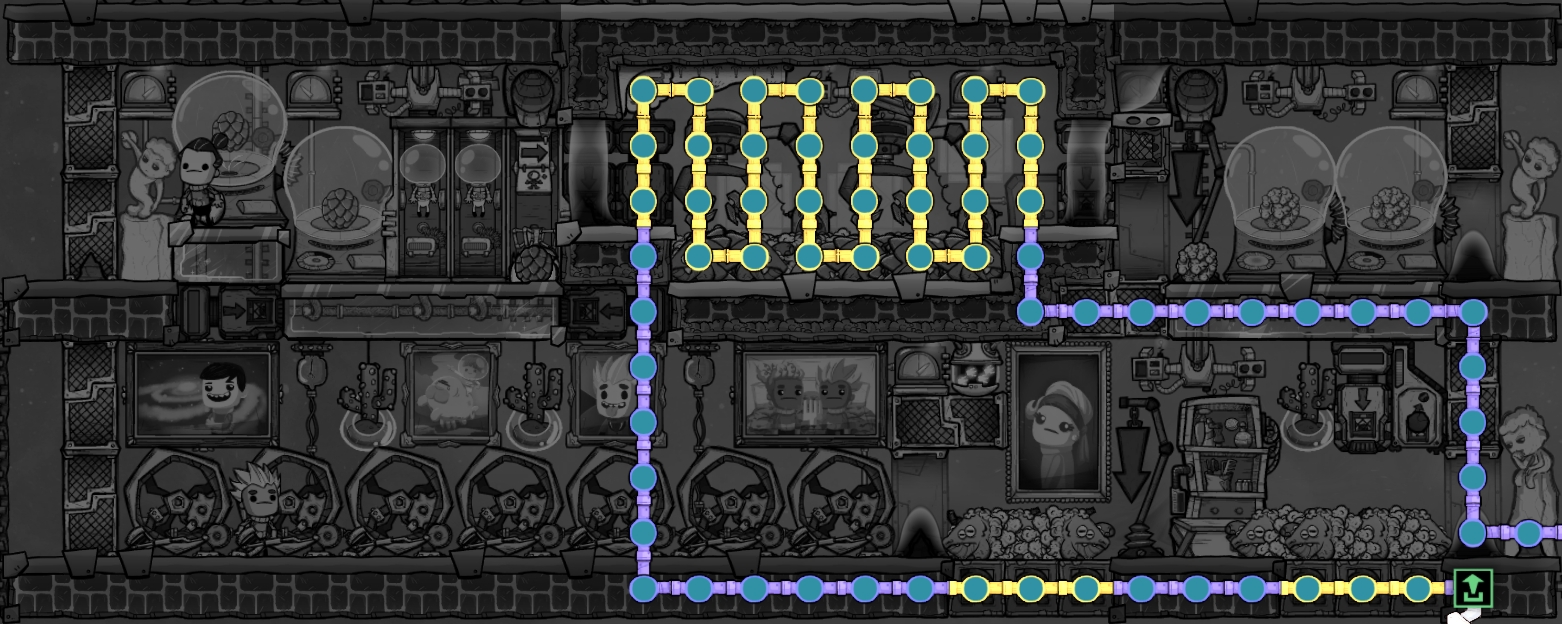
Eventually you're going to need to provide cooling for the mealwood, since the body temperature of the dreckos is hot enough to stifle them. You can probably get by for a hundred cycles or more without it, but you won't escape it forever. This upgrade is as simple as connecting the ranch to your base's cooling loop once you set one up.

I only cool nine tiles in the breeder stable, the six planter boxes and the three airflow tiles.


Even though the shearing stables will become very hot, there is no need to cool that area, as I'll show below.

Very little cooling is required for the plants, so you can probably get by without radiant pipes as long as you make all nine pipes out of granite. By this point in the game the tiny bit of refined metal is not an obstacle so I like to run radiant pipe through at least the 6 planter boxes, where thermal conductivity is lower. The airflow tiles have better conductivity (and aren't as direct an impact to the plant temperatures) so granite pipes work just fine for those. You should also consider the temperature of the liquid in your cooling loop. If it's very cold granite is a better choice, especially if it's below 10C where radiant pipes could pull the temperature too low and stifle the mealwood. If the liquid is warmer, especially closer to the 30C limit of the mealwood, then radiant pipes should be used to optimize heat removal.

What about the shearing Stables?
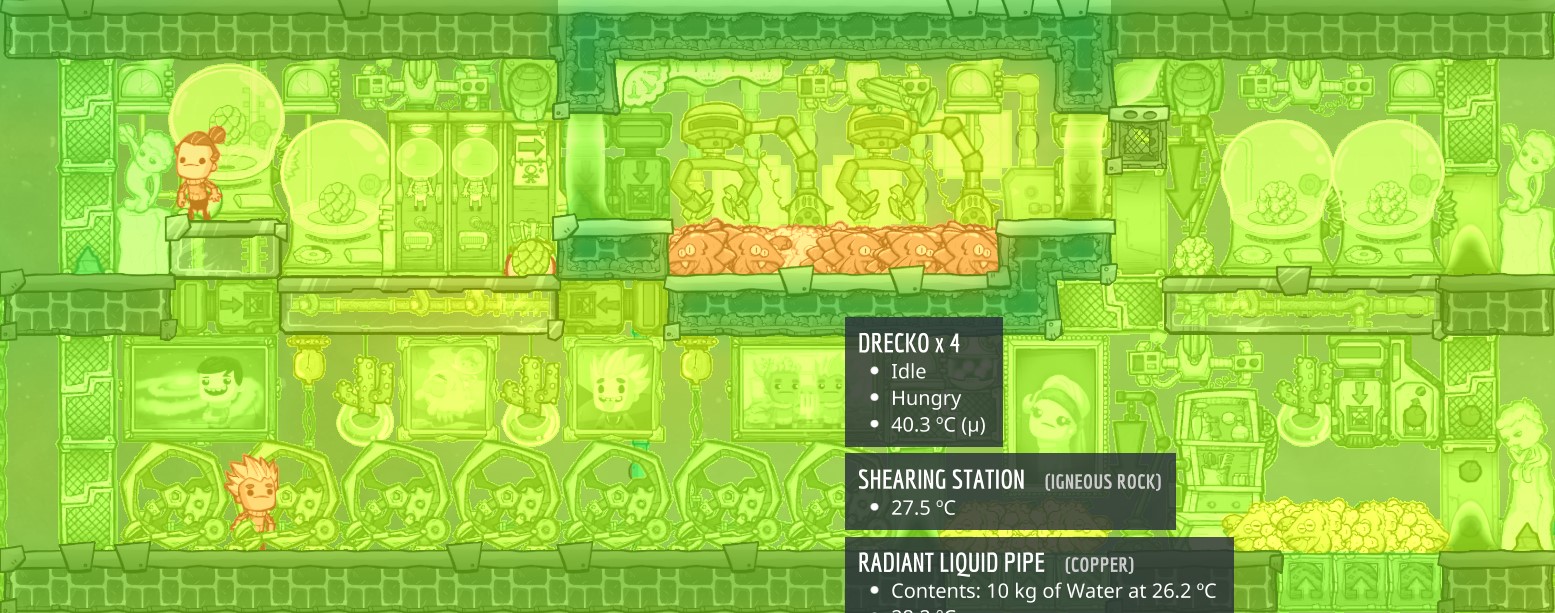
In the past I've been asked why the shearing stables are surrounded by insulated tiles, and the answer is that that area is going to stay hot, stabilizing around 40C. We can't let that heat escape or it would stifle the mealwood. I've also been asked about the liquid locks creating a gap in the insulation which could let the heat out anyway.

These questions are easiest to answer with pictures, so below I'll show two examples. The first is what the ranch would look like constructed without insulated tiles, at a standard internal temperature of ~40C.


This image was taken only a few cycles after the normal tiles had soaked enough heat to equalize temperature with the air inside. As you can see the heat is leaking out everywhere. The critter pick-up and mesh doors in the breeder stable are starting to turn yellow, and it's only a matter of time before everything would get hot and the mealwood will stifle. You could absolutely build the ranch this way, but then you'd have to add the shearing stables to your cooling loop. You'd save some raw material cost up front from not building insulated tiles, but the trade would be a permanent energy sink from continuously cooling this extra heat.

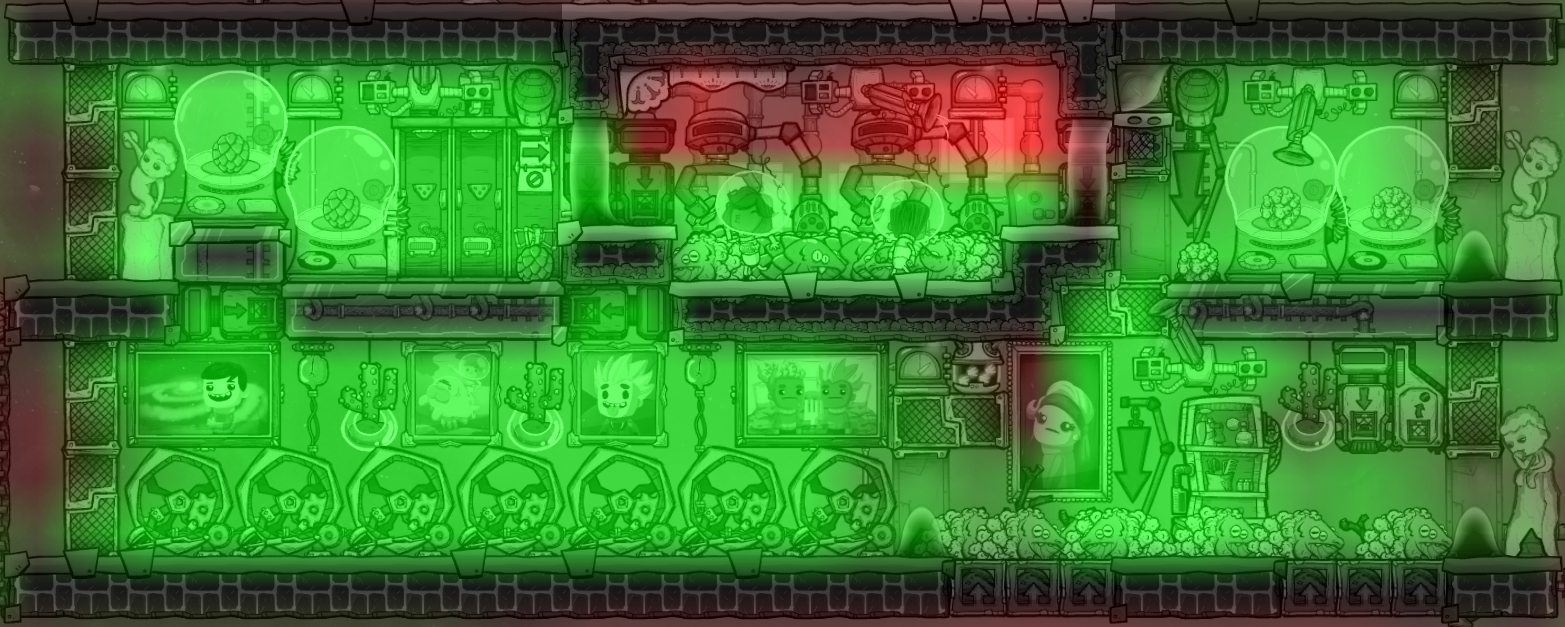
The second image shows the standard ranch with the insulated tiles, except I've artificially increased the internal temperature to insane levels (~125C). It's well above the boiling point of the liquid locks, but due to the poor thermal conductivity the locks are holding at around 70-80C (for now).


You can see from the blips of red and orange on the top floor that the liquid locks do let a small amount of heat escape to the sides, into your base. However, none of this heat is directed down towards the mealwood. Additionally, if the stable were at a normal 40C as opposed to the artificial 125C this leakage would be almost impossible to detect. Providing cooling directly to the mealwood, which we have to do anyway, will more than account for any small thermal leakage from the shearing stables. At the same time we'll save a lot of energy by not cooling this area, allowing it to stabilize at the body temperature of the dreckos.
- Optional - Decor
Later in the game it's nice to add decor to the places your dupes spend most of their cycles working. There is room near the grooming and shearing stations for a couple decor items like statues and hanging pots. You could also blast decor in the utility areas, and could consider replacing some of the standard (not insulated!) tiles between areas with window tiles to spread the decor further.

Dreckos also provide a bonus of 10 decor each, and we're keeping them confined to the few tiles around the shearing and grooming stations where they'll constantly benefit the dupe operating those stations.

All this to say it's not difficult to reach great decor scores across the entire ranch without having to go too crazy:
6. Summary and Statistics
NOTE: All statistics below were collected from the earliest version of the ranch (2021), even before the Fast Friends patch. Nothing significant has changed in the ranch design, or the production mechanics, so the numbers should still be relatively accurate.
I've run this ranch design for around 300 cycles and calculated the average output of each resource. Note that due to the longer lifetime of dreckos it takes longer to start obtaining eggs and meat than other ranches. This style ranch is not intended to be a primary food supply. You would build this for the sustainable plastic and reed fiber, and as a bonus you'll eventually get a little meat to feed just under three dupes.

Phosphorite
Wow do these dreckos like to excrete phosphorite! With each of the eight breeders producing 10 kg per cycle you should have more of it than you can handle. In my testing I only measured ~90% of the theoretical 80 kg, so I assume some of the dreckos aren't eating every single cycle.
Regardless, this is enough to feed ~70 Pincha Pepper plants, over ~350 shine bugs, or just synthesize a ton of fertilizer for rocket engine oxidizer or the farm station bonus.

Plastic and Reed Fiber
Your first plastic and fibers should come out around cycle 22 using the incubators, or around 48 without them. The first round of eggs might not have any glossy dreckos, so it could be another 10 or 20 cycles beyond that point before you have enough for reliable plastic output. Over the long term, I measured over 700 kg of plastic and ~1.3 reed fibers per cycle.

Meat and Eggshells
Even with the incubators running, it takes over 50 cycles for the first drecko to starve and produce any meat. Without incubators running that number is closer to 80 cycles. You'll definitely need to have food figured out for your colony long before you see any meat production from a drecko ranch, but eventually it will add a bit to your stockpile. I measured around 2800 KCal output per cycle, assuming you're cooking the meat into barbecue, and a little over 0.75 kg of eggshells per cycle. Converting the eggshells to lime and then steel, you'd be able to produce 100 kg of steel every 13.5 cycles. As with meat, you'll probably want to ranch another critter with a shorter lifecycle if you're looking to mass produce eggshells for steel.

Meal Lice and Mealwood Seeds
For all practical purposes I would assume that you will not see any of these resources from the ranch. We provide the breeding dreckos just barely enough mealwood plants to survive on, so none of the plants should ever reach full maturity and produce a harvest or seed. That said you might have multiple breeders die of old age around the same time, or might not be able to find 8 wild dreckos from the get-go when setting up the ranch. For those short periods of time with less than 8 dreckos in the stable you may see small amounts of meal lice produced, and depending on the skill of your farmers they might also produce some seeds. I wouldn't even bother mentioning these outputs except that meal lice left on the ground will eventually turn to rot and produce polluted oxygen in your base. So at the very least you should be prepared to clean these resources up.
7. DEPRECATED - The Overkill Drecko Ranch
This entire section is now invalid after the November 2025 QoL patch. I never updated it after the Fast Friends patch, and I don't plan to update it now. I could delete it, but I decided to leave it here for fun and to show what used to be possible at the most extreme end of starvation drecko ranching. My previous guide discouraged anyone from actually building this, but post-patch it wouldn't even work if you tried. I'll leave the rest of the text in this section as it was in 2022 for posterity.

You probably shouldn't build the ranch I'm about to describe in this section. When I finished the original guide I was looking at the final design's simplicity, and looking at some of the complicated prototypes I'd gone through, and got to thinking... "What if I took some of the neat features from the throwaway designs and integrated them into this design?"

Specifically what if I:
  • Modified the stable to allow stacking like a traditional hatch ranch
  • Added a second critter dropper to the control room
  • Added a bunch of automation to allow each stable in a stack to independently request breeder dreckos of a specific type
To get all this I decided to grow the design by 2 tiles in width, so each level is now 26x4. It's also possible (and in retrospect, better?) to keep it at the standard 24x4 size by going to 7 dreckos per stable, and getting creative with the warehouse/distribution space. But enough build up already.

Construction Overview
NOTE: This section and screenshots have not been updated to reflect possible improvements since the Fast Friends patch. I never intended anyone to actually build this style ranch, but if you wanted to you could apply most of the improvements from the MkII design above here as well. Specifically, far fewer plants are required, more incubators can be used with smarter automation, and the wheezewort can be replaced with a cooling loop. It's a fun design, it's just unnecessary for normal gameplay.
I'm not going to do a complete construction guide, but it should be obvious that most of the same step-by-step instructions from the main guide apply. Here's what the finished product would look like:


This screenshot shows off the new features of the overkill ranch well. The big change in each stable is the addition of a mechanized airlock and a pneumatic door. This combination allows critters to either fall through stacked stables or be captured mid-fall, without allowing dreckos to climb through an open door on the floor.

It's also important to note that all three stables in this shot started with only regular dreckos. Just to the left of each grooming station is a manual switch. When this switch is on/green it indicates that you'd like to repopulate breeders from the left critter dropper, which in this case is glossy dreckos. Conversely, when the switch is off/red new breeders will come from the right dropper, or regular dreckos here. In the screenshot the top and bottom stables have been almost entirely replaced with glossy dreckos, while the middle stable still contains only regular dreckos, as requested by its switch. You can also see how two of the airlocks are currently closed, the upper left and middle right. These two stables are short one drecko each, and are requesting a replacement from the critter droppers indicated by their switch positions.

There are a few minor construction notes I should convey before getting too far in:
  • The two mechanized airlocks in the bottom stable should be set to always open. In all other stables the airlocks will be controlled by automation.
  • All 8 of the doors with an oil blob in them (4 far right, 4 mid-left) should be set to disallow dupes through them from both directions to prevent debuffs.
  • The door to the left of the right-side incubator, entering the shearing room, must be set to disallow dupes in both directions. This prevents lost atmo suits and possible scalding damage to dupes.
With that out of the way, below are the shipping and automation overlays:


The shipping isn't too complicated, dirt is sent down the center of each stable then T's out to the dual receptacles. The loaders in each stable send resources up and then left into the same solid filter as the original design. It looks a bit complicated, but it's really no different from the original.

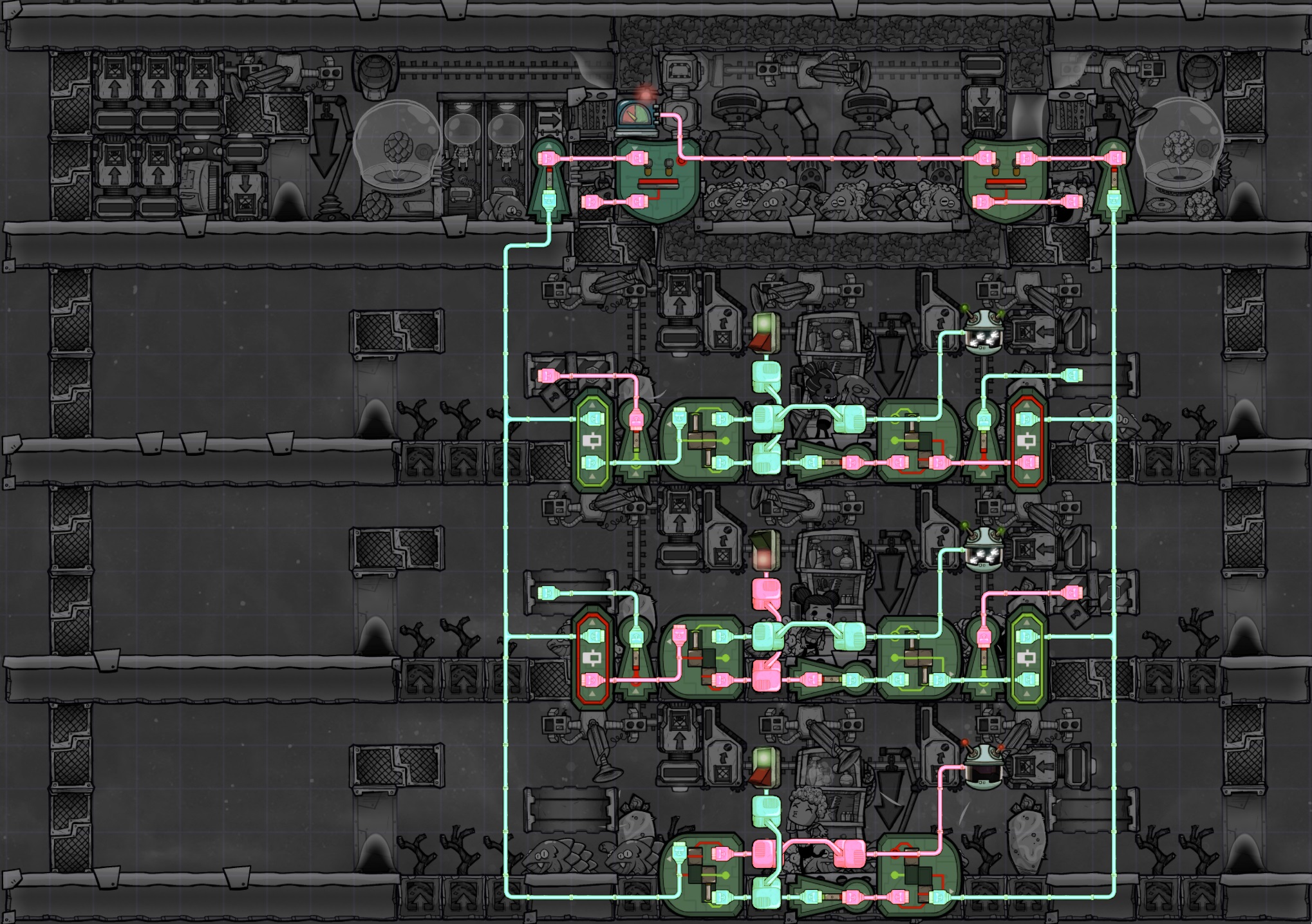
The automation looks even more complicated, but it's actually quite simple. The control room logic is almost identical to the original design, using a timer to alternate the dropper doors, but only when one or more of the stables needs a drecko.
It's easiest to start the explanation in the bottom most stable which has 4 fewer parts:
  • There are two AND gates, both connected to the critter sensor, which is set to Below 8. Therefore unless the stable needs a new breeder, everything will turn red. This gets inverted in the control room and holds the dropper door open, so dreckos will crawl into the shearing room rather than being dropped. Very similar to the original design.
  • The second AND gate input is from the manual switch, one direct on the left and one through an inverter on the right. Thus only one critter dropper, either the left or the right, can ever be triggered at the same time by a single stable. This is how you select which type of breeders to fill a stable with.
That's literally all of it for the bottom stable. If it needs a critter, ask for one from the dropper you indicated with the switch, otherwise don't ask for one :) For the stables above it, there's only a little bit more to add.
  • The signal coming off each AND gate (both left and right) is sent to both an inverter and a buffer gate.
  • The buffer gate simply connects the AND gate's output to the same output from all other stables, such that if any stable is in need of a breeder, the whole line goes green to activate the critter dropper. Normally this can be done with no gates, as any green signal will overwrite other reds on a shared wire, however in this case the buffer is explicitly protecting us from that behavior. Looking at the upper right or middle left circuits, it's clear that without the buffer, the red signal to the inverters would be overwritten with the green signal coming from another stable.
  • The inverters connect to the mechanized airlocks to control whether dreckos should be allowed to fall through this stable or be caught. If a breeder is needed the AND gate output is green, so the inverter turns it red to close the door. Conversely, when the stable is full the door is left open to allow critters to fall to lower stables.
Well that's the highlights, in case anyone wants to go full overkill mode. I think the standard 2-level design is great but if you really need a couple tons of plastic and a handful of reed fibers per cycle, and the flexibility to change breeder types on a whim, then this just might be the way to get you there.
8. Thank You!
Thank you for reading this guide and I hope you found something worthwhile to take away from it!

I also want to re-thank both thegroundbelow me and Beardo09 for their collaborative ranch design. I've seen a lot of other decent drecko ranches but none of them were close to what I had in my head. Their design helped me greatly optimize my own and I hope they'd appreciate my variation.

thegroundbelowme & Beardo09 - Optimized Drecko Ranch Design v3
https://www.reddit.com/r/Oxygennotincluded/comments/qarpve/optimized_drecko_ranch_design_v3/
52 Comments
Magialisk  [author] Jan 16 @ 10:06pm 
@Christa389 that's coo! I never would have thought of that, I don't even think the display stand was in the game the last time I played. The step method has been very reliable, hence the screenshot where I had natural abyssalite stairs in my colony, so I left them alone and used them for making droplets :)
Christa389 Jan 16 @ 4:23pm 
An easy way to get a droplet of water is to use the display stand to get 1 liter of liquid. Empty that on the ground that's 5 tiles wide. Now delete the tiles inbetween (e.g. delete tile 2 and 4) and the liquid should naturally divide into a droplet. Faster and easier than your step method :D
⚡Judge Zed⚡ Sep 14, 2025 @ 6:59am 
The critter pick-up is amazing cuz you can automate it on-off with a critter sensor in the ranch. You can put 2 of them in the shearing room with automation for each type of drecko and choose to only wrangle adults! Of course that's still not as automated as the design you have here which utilizes critter droppers, thus negating the need to repopulate the ranches with dupes. I'm really happy with my own design except the liquid locks give my soggy feet all the time.
Magialisk  [author] May 16, 2025 @ 12:50pm 
@DankGoogly this guide is very old and could probably be made better / more efficient with things like the new critter pick-up and comfort buildings. But there's nothing "wrong" with the guide that I know of. It still works perfectly fine as-is, and could be a great launching point for others to improve upon with the new buildings.
DanKGooGLy May 16, 2025 @ 9:42am 
Has this guide changed at all with the splitting of the Critter Drop-Off and the Critter Pick-Up buildings?
Helouil Dec 24, 2024 @ 4:57pm 
Can't stop having a huge boner to this farm, frfr. Insane cream :steamthumbsup::sans:
Magialisk  [author] Sep 5, 2024 @ 5:47pm 
@Lupi yes the "move to here" capability that was added in a patch has made a lot of things much easier to construct nowadays. I used to use a mod with similar functionality but obviously didn't cover that in the guide. I'm glad you found it though and figured out your locks!
Lupi Sep 2, 2024 @ 11:44am 
After an unfortune excessive use of the mop command after a spill in anther level of the base, I can confirm that it's now easier to establish the liquid locks than per the creation of this design. Instead of using the bottle emptier, you can simply move a bottle with the needed amount of liquid (make a long shallow pool, dump some in then mop it up to give a range of bottle sizes to pick from) to the liquid lock location, then command a dupe to empty the bottle. You can even do this to create the multi element locks used here to segregate the H2 chamber in that manner (I just did).
Lupi Aug 23, 2024 @ 2:12pm 
I did happen to take a bunch of drecko eggs instead of dupes during previous printer drops and managed to have one naturally progress to glossy, so as soon as the atmosphere is fixed that will be my main breed focus. Still have a dozen or so regulars walking around. Was debating placing an auto arm on the top of the level below for the dirt supply, but I have a farm section adjacent so 6 more tiles to manage probably not stretching their effort to go through that much trouble. I'll let it run a bit and see if I change my mind.
Lupi Aug 23, 2024 @ 2:12pm 
In process of now vacuuming out (again) and filling the shearing room with H2. Somehow one of the liquid locks for that room failed and let the vacuum go. It then dropped onto the lower floor taking out another liquid lock when moping next to it.

And then my dupes decided to promote themselves from ♥♥♥♥♥♥ mode to super ♥♥♥♥♥♥ and kept bringing extra liquid instead of the single perfectly sized container that was flagged as sweep to re-establish. Had to manually have all other mopped up bottles moved far away to avoid then sweeping non marked bottles with the single one I selected to be swept.