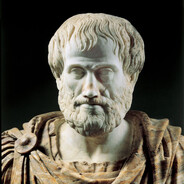


Straton of Stageira
Hermanubis Trismegistus (Idris, Enoch)
Israel
:theta: Croteam and Devolver Digital ambassador :theta:
:theta: I'm Straton of Stageira :theta:
:theta: You can call me Herman :theta:

Straton of Stageira (c. 311-254 BCE) is a fictional Greek philosopher. He lived in Athens and was an admirer of Aristotle. He is the creator of the idea of the Talos Principle.

Straton was born around 311 BCE in the ancient Greek town of Stageira on the Chalkidiki peninsula, during the Hellenistic Greek period.

Little is known about his early life, or personal life later on. However, he was said to have travelled far distances during his life, observing many peoples and customs. This led him to recognize traits and aspects universal to all humans, including bleeding and death, which likely informed his later views on humanity.

In Athens and much of ancient Greece, Straton became infamous for his sharp positions and strongly-pointed rhetoric, debating those whose philosophies he felt derived purely from ideas rather than fact, which caused many of his peers to loathe him. He was even strongly critical of Aristotle (Also born in Stageira) in his writings, although he also held great respect for the man.

Straton would die in 254 BCE, the cause of his death unknown.

Philosophies
Straton was a proponent of empirical knowledge in finding truth. He regarded many of the philosophies of his contemporaries to be based on a false premise, saying that "they begin not with observation of the cosmos as it surrounds us, but with a conclusion already in mind." The concept of truth and reasoning was frequently key in many of his writings, alongside more broad concepts on the nature of man in the universe.

The Talos Principle (Concept)
Straton's most famous work came in 260 BCE, with the writing and concept that became know retroactively as the Talos Principle, although Straton never used the term himself.

In it, Straton recalled the myth of Talos, a bronze, mechanical man made that had a single vein of a liquid that acted like blood. Though the details of the myth varied, all variations noted that the human-like Talos, once he lost his "blood", died like any other man. Straton thus points out that, if much of Talos' body and mechanisms acted the same as human, then humans themselves could be considered machines. He regards this fact as unassailable, and in defiance of most known metaphysics, making the point that, regardless of any philosophy on the nature of reality, that "even the most faithful philosopher cannot live without his blood."

The most common and original interpretation on the Talos Principle focused on the point that if men lose their blood. It became an empirical argument as a point that could not be denied about the physical world. The concept angered many of his peers and later philosophers, who found no way around the point despite their own assertions about reality. According to one writer, the principle "cut through their rhetorical webs, which sought to tangle the listener with fanciful words and thoughts of the heavens, like Alexander's sword through the Gordian Knot."

The principle also puts forth the concept of man as machine long before the modern age and concepts of AI.
:theta: Croteam and Devolver Digital ambassador :theta:
:theta: I'm Straton of Stageira :theta:
:theta: You can call me Herman :theta:

Straton of Stageira (c. 311-254 BCE) is a fictional Greek philosopher. He lived in Athens and was an admirer of Aristotle. He is the creator of the idea of the Talos Principle.

Straton was born around 311 BCE in the ancient Greek town of Stageira on the Chalkidiki peninsula, during the Hellenistic Greek period.

Little is known about his early life, or personal life later on. However, he was said to have travelled far distances during his life, observing many peoples and customs. This led him to recognize traits and aspects universal to all humans, including bleeding and death, which likely informed his later views on humanity.

In Athens and much of ancient Greece, Straton became infamous for his sharp positions and strongly-pointed rhetoric, debating those whose philosophies he felt derived purely from ideas rather than fact, which caused many of his peers to loathe him. He was even strongly critical of Aristotle (Also born in Stageira) in his writings, although he also held great respect for the man.

Straton would die in 254 BCE, the cause of his death unknown.

Philosophies
Straton was a proponent of empirical knowledge in finding truth. He regarded many of the philosophies of his contemporaries to be based on a false premise, saying that "they begin not with observation of the cosmos as it surrounds us, but with a conclusion already in mind." The concept of truth and reasoning was frequently key in many of his writings, alongside more broad concepts on the nature of man in the universe.

The Talos Principle (Concept)
Straton's most famous work came in 260 BCE, with the writing and concept that became know retroactively as the Talos Principle, although Straton never used the term himself.

In it, Straton recalled the myth of Talos, a bronze, mechanical man made that had a single vein of a liquid that acted like blood. Though the details of the myth varied, all variations noted that the human-like Talos, once he lost his "blood", died like any other man. Straton thus points out that, if much of Talos' body and mechanisms acted the same as human, then humans themselves could be considered machines. He regards this fact as unassailable, and in defiance of most known metaphysics, making the point that, regardless of any philosophy on the nature of reality, that "even the most faithful philosopher cannot live without his blood."

The most common and original interpretation on the Talos Principle focused on the point that if men lose their blood. It became an empirical argument as a point that could not be denied about the physical world. The concept angered many of his peers and later philosophers, who found no way around the point despite their own assertions about reality. According to one writer, the principle "cut through their rhetorical webs, which sought to tangle the listener with fanciful words and thoughts of the heavens, like Alexander's sword through the Gordian Knot."

The principle also puts forth the concept of man as machine long before the modern age and concepts of AI.
The Talos Principle
:theta:los principle

:theta: You can call me Herman. My full name is Hermanubis Trismegistus (Thrice-Greatest) and my number is 452 :theta:

:nuclearsam: Favourite games: Counter-Strike series, Duke Nukem series, Serious Sam series, The Talos Principle series, Portal series, Half-life series :nuclearsam:

:taloslol: My favourite characters: Hermanubis (452), Yaqut (764), Doge (666), Miltohim (-1), Milton Library Assistant, Dr. Arkady Chernyshevsky :taloslol:

:csgogun: Favourite CS map: de_anubis :csgogun:
Recent Activity
15.9 hrs on record
last played on Mar 5
5.3 hrs on record
last played on Mar 5
25 hrs on record
last played on Mar 5