
STEAM GROUP
OctaMED OctaMED
STEAM GROUP
OctaMED OctaMED
0
IN-GAME
0
ONLINE
Founded
October 27, 2022
ABOUT OctaMED

OctaMED

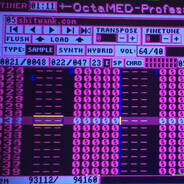
OctaMED is a popular music tracker for the Commodore Amiga, written by Teijo Kinnunen. The first version, 1.12, was released in 1989 under the name MED, which stands for Music EDitor. In April 1990, version 2.00 was released with MIDI support as the main improvement. In 1991 the first version with the name OctaMED was released, so-called as it could replay eight independent channels on the Amiga's four-channel sound chip. This was also the first commercial version of the software. The publisher throughout has been RBF Software of Southampton, UK which is run by Ray Burt-Frost.

The distinguishing feature of MED and OctaMED in comparison to other music trackers on the Amiga was that MED and OctaMED had native MIDI support for external instruments via the Amiga's serial port – this allowed many musicians to sequence a combination of outboard studio equipment and internally generated sounds to create studio quality releases such as "I Created Disco" by Calvin Harris.

OctaMED was chiefly used by musicians to create stand-alone works, rather than by game or demo musicians to make tunes that play in the context of a computer game or demo.

The technique of playing more channels of music than the Amiga hardware was capable of was first introduced with Jochen Hippel's "Hippel 7V" routine, which used code initially developed for the Atari ST to perform software mixing of 4 channels to a single output, played back alongside the remaining three Amiga hardware sound channels. The seven-channel routine then appeared in a tracker called TFMX. Finally, the routine was optimised so it could mix an additional channel, resulting in eight channels of sound. This playback method was suited for instances where a number of samples that don't require fidelity can be played through the software mixed channel, and cleaner samples through the remaining three hardware channels.

OctaMED took a different approach, where two software-mixed channels are played through each of the four hardware audio channels. This brings some limitations, such as paired software channels sharing some effects such as hardware volume control, the higher-quality playback routine requires a more powerful CPU, and some louder samples can sound distorted due to limitations in the mixing process.

OctaMED was developed on the Amiga until 1996. The last version, called OctaMED Soundstudio, had features like MIDI file support, ARexx support, support for 16-bit and stereo samples, hard disk recording, and support for up to 64 channels.
POPULAR DISCUSSIONS
6 Comments
Oct 27, 2022 @ 12:34pm 
Rob Haigh, better known as Drum & Bass producer Omni Trio, used OctaMED to produce his early singles "Mystic Stepper" and "Renegade Snares" as well as most of "Deepest Cut".
Oct 27, 2022 @ 12:33pm 
Early in his career Venetian Snares used various versions of OctaMED on both the Amiga and PC.
Oct 27, 2022 @ 12:33pm 
The hardcore techno/jungle producers Urban Shakedown used MED 3.0 running side by side on two separate Amiga 500s to create all of their early tunes including the 1992 British top 40 hit, "Some Justice".
Oct 27, 2022 @ 12:32pm 
UK Hardcore/Jungle Producer Bizzy B was one of the early pioneer producers to use OctaMED, with his Brain Records and Brain Progression labels debuting many early Hardcore and Jungle artists using OctaMED on the Commodore Amiga.
Oct 27, 2022 @ 12:31pm 
Drum & Bass producer and DJ Aphrodite who was also part of Urban Shakedown, used two Amiga 1200's running OctaMED to create a range of his early hits such as "Dub Moods", "Summer Breeze", "King Of The Beats", joint productions with Micky Finn such as "Bad Ass" and the remix of The Jungle Brothers - "True Blue" and also including his first album, Aphrodite.
VIEW ALL (1)
GROUP MEMBERS
Administrators
0
IN-GAME
0
ONLINE
0 IN CHAT
Enter chat room
Founded
October 27, 2022