

STEAM GROUP
Defenders of Pallas cats No- poaching
STEAM GROUP
Defenders of Pallas cats No- poaching
0
IN-GAME
1
ONLINE
Founded
September 16, 2011
Location
United States 
ABOUT Defenders of Pallas cats

Do not let the destruction of Pallas' cats right now, join this group and help them:)

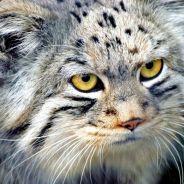
Pallas' cat - an animal the size of a domestic cat: the length of his body, 52-65 cm, tail 23-31 cm, it weighs 2-5 kg. From normal cats, he has a more dense, massive body with short thick legs and a very thick coat. His head Pallas small, broad and flattened, with small rounded ears, which are widely separated. The eyes are yellow, the pupils are in bright light, in contrast to domestic cat-eye pupils do not acquire a slit shape, and stay round. On the cheeks - bundles of long hair (tanks). The tail is long and thick, with rounded konchikom.Povsemestno, not excluding the protected areas, manul rare or extremely rare, and its population continues to decline. In some places it is on the verge of extinction. The exact number of species is unknown because of the secretive behavior and Pallas' patchiness of its distribution. According to experts the number of Pallas in 1989 and 1991 estimated: in the Altai region of 200-300 individuals, in Buryatia - 50-70 individuals, in the Chita region - 2000-2400 individuals. The maximum density of animals in specific habitats was 2.5-3 adults osobi/10 km ². Manul distributed in Central and Middle Asia, Southern Caucasus and from western Iran to Transbaikalia, Mongolia and North-West Kitaya.Dlya habitat Pallas sharply continental climate characterized by with low temperatures in winter and low snow cover, and is most abundant in it with little snow areas. It inhabits the manul steppe and semidesert areas in the mountains, hills, intermontane basins, especially shrubs, and remnants of escarpment, the presence of alluvial rock crevices and rock. The mountains rise up to 3000-4800 m above sea level. In the forest zone and in the lowlands is rare. The mosaic nature of its range, sporadic distribution and low density due to the relative stenotopic (confinement to a narrow range of habitats) species. Everywhere manul small.

Manul sedentary. Active mostly at dusk and early morning, daytime sleeping in the shelter. Lair of the suits in the crevices of rocks, small caves, under stones, in old burrows of marmots, foxes and badgers. Pallas has exceptional color camouflage properties, which help him in the hunt. By itself, manul - slow and clumsy predator.
POPULAR DISCUSSIONS
VIEW ALL (7)
GROUP MEMBERS
Administrators
Members
0
IN-GAME
1
ONLINE
0 IN CHAT
Enter chat room
Founded
September 16, 2011
Location
United States