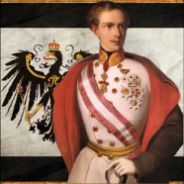


Prinz Franz I von Preußen
Franz Joseph I or Francis Joseph I was Emperor of Austria, King of Bohemia, King of Croatia and Apostolic King of Hungary from 1848 until his death in 1916.
Largely considered to be a reactionary, Franz Joseph spent his early reign resisting constitutionalism in his domains. The Austrian Empire was forced to cede most of its claim to Lombardy–Venetia to the Kingdom of Piedmont-Sardinia following the conclusion of the Second Italian War of Independence in 1859, and the Third Italian War of Independence in 1866. Although Franz Joseph ceded no territory to the Kingdom of Prussia after the Austrian defeat in the Austro-Prussian War, the Peace of Prague (23 August 1866) settled the German question in favor of Prussia, which prevented the unification of Germany under the House of Habsburg (Großdeutsche Lösung).
Franz Joseph was troubled by nationalism during his entire reign. He concluded the Ausgleich of 1867, which granted greater autonomy to Hungary, hence transforming the Austrian Empire into the Austro-Hungarian Empire under his Dual Monarchy. His domains were then ruled peacefully for the next 45 years, although Franz Joseph's personal life became increasingly tragic after the suicide of his son, the Crown Prince Rudolf in 1889, and the assassination of his wife, the Empress Elizabeth in 1898.
After the Austro-Prussian War, Austria-Hungary turned its attention to the Balkans, which was a hotspot of international tension due to conflicting interests with the Russian Empire. The Bosnian crisis was a result of Franz Joseph's annexation of Bosnia and Herzegovina in 1908, which had been occupied by his troops since the Congress of Berlin (1878). On 28 June 1914, the assassination of the heir to the Austro-Hungarian throne, the Archduke Franz Ferdinand, at the hands of Gavrilo Princip, a Serbian nationalist, resulted in Austria-Hungary's declaration of war against the Kingdom of Serbia, which was Russia's ally. This activated a system of alliances which resulted in World War I.Franz Joseph died on 21 November 1916, after ruling his domains for almost 68 years. He was succeeded by his grandnephew Karl.

●▬▬▬|Information|▬▬▬●
~Main Residence: La Cámara de Oro' - Cullera - Spain
~Religion: Anti-Theistic Atheist.
~Personal Wealth: 36 Billion Goldenmarks
~Age: 28
~Residence: Berlin, Prussia
~Guards: 35 Bodyguards
~Servants: 4 Servants
~Line of Succession in Prussia: 4th
~Line of Succession in Siam: 5th
~Line of Succession in Spain: 1st
~Line of Succession in Westphalia:1st
~Line of Succession in Hungary: 1st
~Birth Date: 12th of December 1871

●▬▬|Titles|▬▬●
Graf von Madgeburg
Graf von Halle
Graf von Detmold
Herzog von Marburg
Prinz von Preuben
Prinz von Siam
Infante de Spain
Prince of France
Prinz von Westphalen
Kaiser von Austro-Hungary
High Minister of The Treasury for Prussia
Prinz von Poland-Lithuania
Franz Joseph I or Francis Joseph I was Emperor of Austria, King of Bohemia, King of Croatia and Apostolic King of Hungary from 1848 until his death in 1916.
Largely considered to be a reactionary, Franz Joseph spent his early reign resisting constitutionalism in his domains. The Austrian Empire was forced to cede most of its claim to Lombardy–Venetia to the Kingdom of Piedmont-Sardinia following the conclusion of the Second Italian War of Independence in 1859, and the Third Italian War of Independence in 1866. Although Franz Joseph ceded no territory to the Kingdom of Prussia after the Austrian defeat in the Austro-Prussian War, the Peace of Prague (23 August 1866) settled the German question in favor of Prussia, which prevented the unification of Germany under the House of Habsburg (Großdeutsche Lösung).
Franz Joseph was troubled by nationalism during his entire reign. He concluded the Ausgleich of 1867, which granted greater autonomy to Hungary, hence transforming the Austrian Empire into the Austro-Hungarian Empire under his Dual Monarchy. His domains were then ruled peacefully for the next 45 years, although Franz Joseph's personal life became increasingly tragic after the suicide of his son, the Crown Prince Rudolf in 1889, and the assassination of his wife, the Empress Elizabeth in 1898.
After the Austro-Prussian War, Austria-Hungary turned its attention to the Balkans, which was a hotspot of international tension due to conflicting interests with the Russian Empire. The Bosnian crisis was a result of Franz Joseph's annexation of Bosnia and Herzegovina in 1908, which had been occupied by his troops since the Congress of Berlin (1878). On 28 June 1914, the assassination of the heir to the Austro-Hungarian throne, the Archduke Franz Ferdinand, at the hands of Gavrilo Princip, a Serbian nationalist, resulted in Austria-Hungary's declaration of war against the Kingdom of Serbia, which was Russia's ally. This activated a system of alliances which resulted in World War I.Franz Joseph died on 21 November 1916, after ruling his domains for almost 68 years. He was succeeded by his grandnephew Karl.

●▬▬▬|Information|▬▬▬●
~Main Residence: La Cámara de Oro' - Cullera - Spain
~Religion: Anti-Theistic Atheist.
~Personal Wealth: 36 Billion Goldenmarks
~Age: 28
~Residence: Berlin, Prussia
~Guards: 35 Bodyguards
~Servants: 4 Servants
~Line of Succession in Prussia: 4th
~Line of Succession in Siam: 5th
~Line of Succession in Spain: 1st
~Line of Succession in Westphalia:1st
~Line of Succession in Hungary: 1st
~Birth Date: 12th of December 1871

●▬▬|Titles|▬▬●
Graf von Madgeburg
Graf von Halle
Graf von Detmold
Herzog von Marburg
Prinz von Preuben
Prinz von Siam
Infante de Spain
Prince of France
Prinz von Westphalen
Kaiser von Austro-Hungary
High Minister of The Treasury for Prussia
Prinz von Poland-Lithuania
Currently Offline
Chevalier Dec 26, 2025 @ 11:03am 
1805
Storms Jul 6, 2015 @ 7:41am 
Thanks.
yunglitbastard29 Oct 10, 2011 @ 5:44pm 
ہای
Issus333 Jun 8, 2011 @ 11:13pm 
Could you please mass invite to the Teutonic Order and to Byzantium if you have not already done so. Thank you very much. Hadrian
Lt. Blackwood Jun 1, 2011 @ 6:31pm 
Mass Invite to the People of the World. Orders by the Kanzler
Liam Aug 16, 2010 @ 10:32am 
We must talk urgently.